
🐋 Washington Just Started Stockpiling the Metal Nobody Wanted
Lithium fell eighty percent, then nearly tripled. The most interesting buyer in the market isn't a fund — it's the federal government.

Desmond Hawk | July 16, 2026
Here is a number that should stop you: eight thousand two hundred and fifty-nine dollars.
That is what a tonne of battery-grade lithium carbonate cost in June of last year. At the peak in late 2022, the same tonne fetched roughly eighty thousand. A ninety percent collapse in thirty months. Mines shut. Australian producers walked away from working pits. Exploration budgets were cut to the bone. The trade was dead, and everyone agreed it was dead.
This morning it trades around twenty-four thousand.
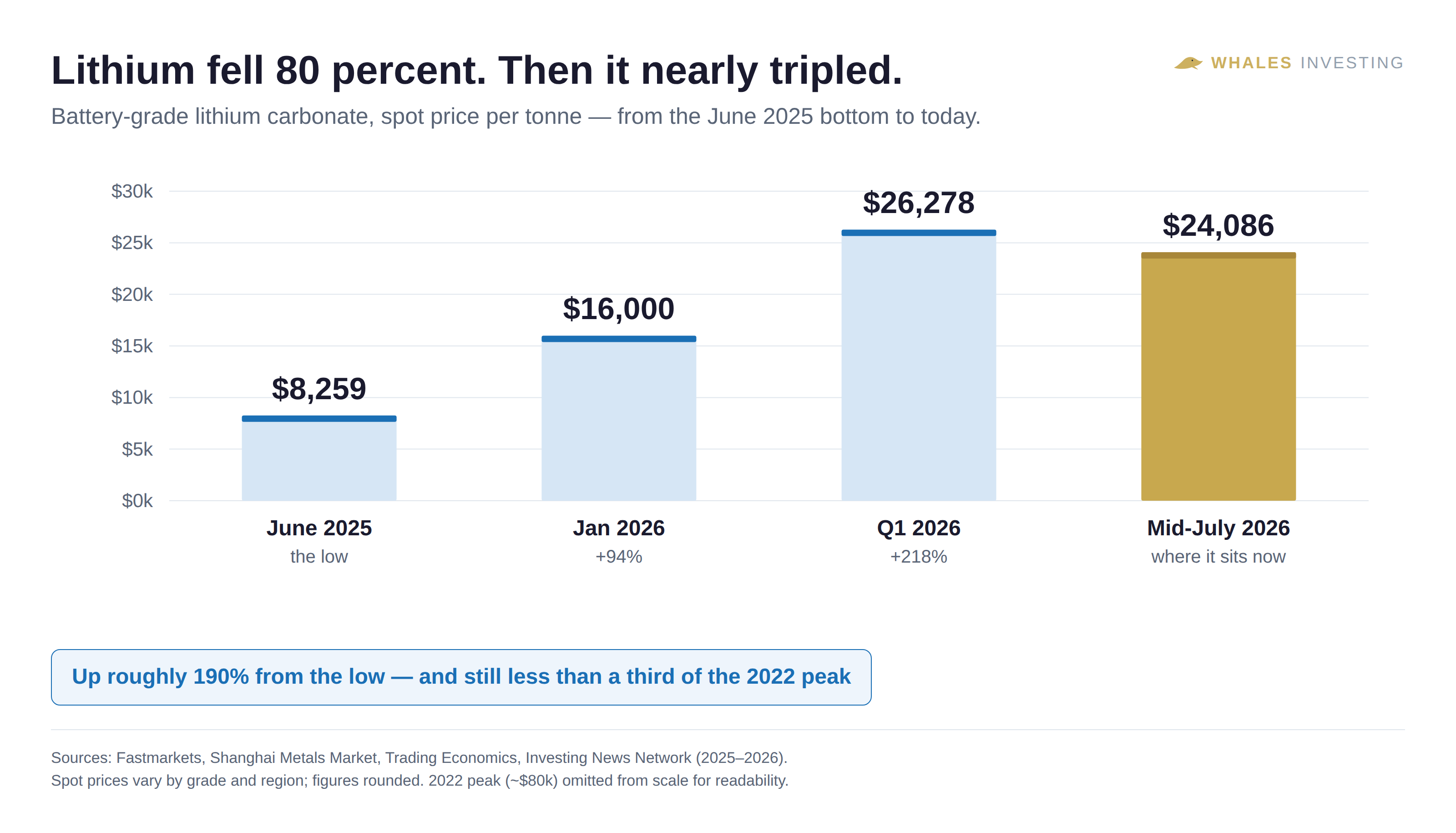
Nearly a triple off the bottom, and almost nobody outside the commodity desks noticed, because the recovery happened while everyone was staring at semiconductors and the Fed.
That’s not the interesting part. This is: while the price was collapsing, and while the crowd was writing lithium’s obituary, the United States government started buying.
What Washington did while nobody was looking
On February 2nd of this year, the President signed an executive order creating something called Project Vault. Twelve billion dollars — ten from the Export-Import Bank, the largest single commitment in that institution’s ninety-two-year history, plus roughly two billion in private capital from names including General Motors, Boeing and Google.
Its purpose is to buy critical minerals — rare earths, cobalt, graphite, lithium — and physically store them. A strategic reserve, built in the image of the Strategic Petroleum Reserve, except for the metals that go into batteries, semiconductors and jet engines.
The Geopolitical Monitor called it the most aggressive American stockpiling initiative since the Korean War. That is not a phrase anyone uses lightly.
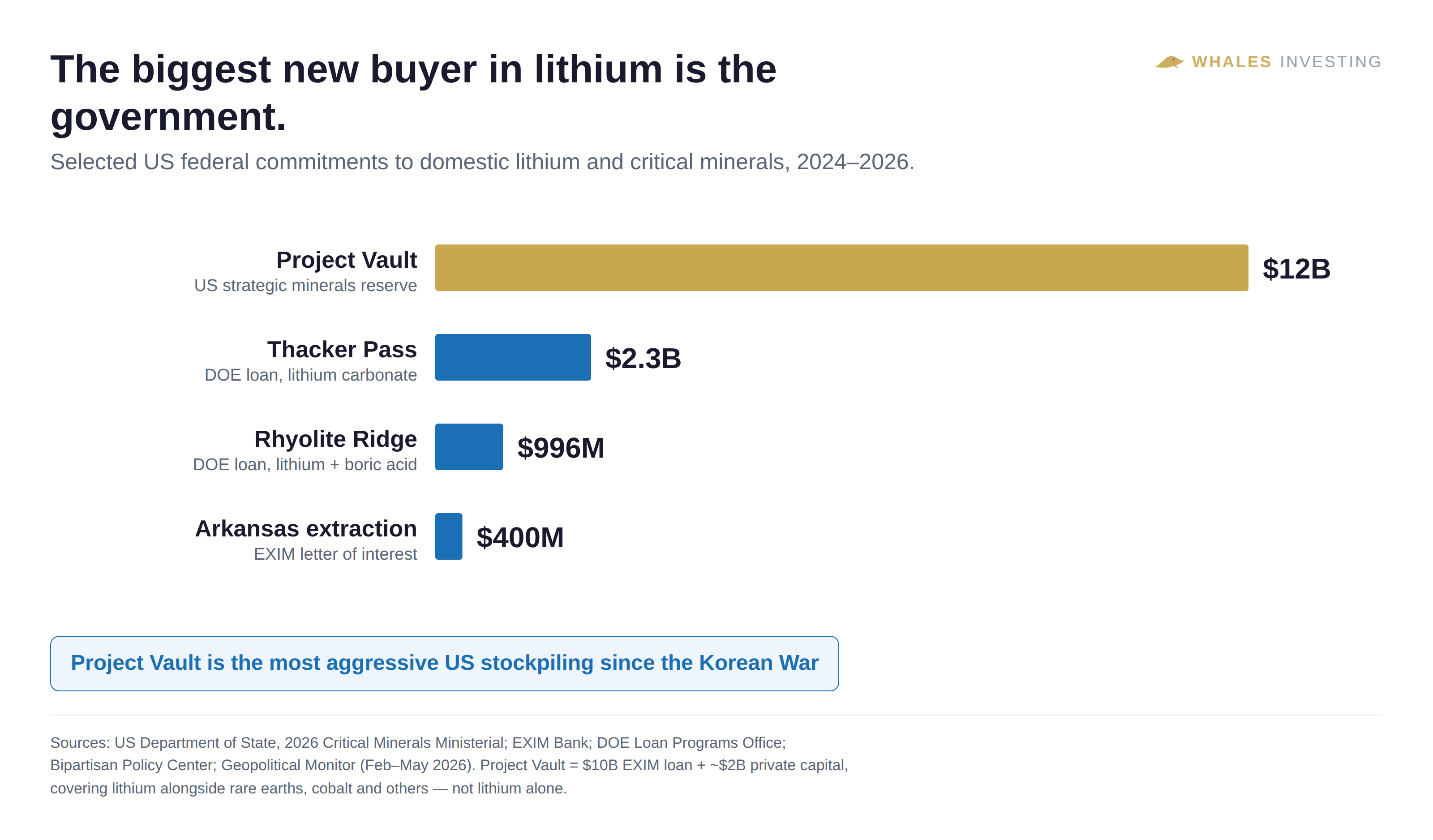
And Vault is only the headline. Underneath it: a $2.3 billion Department of Energy loan to Lithium Americas for Thacker Pass in Nevada. Another $996 million to Ioneer’s Rhyolite Ridge. Four hundred million in EXIM interest for lithium extraction in Arkansas. Over the past year, EXIM has issued nearly fifteen billion dollars in letters of interest across critical minerals projects.
Read that sequence again, with the price chart beside it. The federal government committed billions to lithium during the worst price collapse in the metal’s history.
SPONSORED

How Texas Will Become a Lithium Powerhouse
Texas just made history. EnergyX commissioned the largest lithium production demo facility of its kind in the state, and they’re just getting started.
America needs 5X more lithium by 2040. But supply deficits are already forming, with Morgan Stanley projecting an 80K-ton shortage this year alone. So oil giants like Exxon and Chevron have been buying up land in Texas, America’s emerging lithium hotspot.
EnergyX’s patented technology produces up to 3X more lithium than conventional methods at 500X the speed. Not only that, they have rights to nearly 50,000 acres of lithium-rich Texas land with 3M+ untapped tons, part of a global portfolio with up to 15M+ tons.
This isn’t a concept. The facility is live, producing lithium today. General Motors, POSCO, Eni, and 50,000+ investors have already backed them.
Disclaimer: Energy Exploration Technologies, Inc. (”EnergyX”) has engaged Dynamic Industries to publish this communication in connection with EnergyX’s ongoing Regulation A offering. Dynamic Industries has been paid in cash and may receive additional compensation. Dynamic Industries and/or its affiliates do not currently hold securities of EnergyX. This compensation and any current or future ownership interest could create a conflict of interest. Please consider this disclosure alongside EnergyX’s offering materials. EnergyX’s Regulation A offering has been qualified by the SEC. Offers and sales may be made only by means of the qualified offering circular. Before investing, carefully review the offering circular, including the risk factors. The offering circular is available at invest.energyx.com. Comparisons to other companies are for informational purposes only and should not imply similar results.
Why now, and why this metal
The reasoning isn’t complicated once you see the dependency.
China processes over seventy-five percent of the world’s lithium into battery chemicals. It leads production in thirty of the sixty minerals on the USGS critical list, and holds the leading refining position in nineteen of the twenty strategic minerals the IEA tracks — averaging roughly seventy percent market share. The United States is fully import-dependent for twelve critical minerals and more than half dependent for another twenty-nine.
In 2025, China restricted exports of heavy rare earths — dysprosium, terbium — the materials that go into fighter jet actuators and missile guidance. That was the moment the abstraction became concrete. You cannot negotiate your way out of a supply chain you do not control.
A country that stockpiles a commodity is not forecasting its price. It is admitting it cannot afford to be without it.
Meanwhile the demand math has quietly turned. Batteries now account for eighty-eight percent of global lithium end-use, per the USGS. Grid storage demand jumped seventy-one percent in 2025 and is forecast to grow another fifty-five percent this year — driven partly by the power loads of AI data centres, which need somewhere to put electricity when the grid can’t deliver it on demand.
Supply, meanwhile, spent two years being dismantled. That is what an eighty percent price collapse does: it doesn’t just idle production, it kills the projects that would have supplied the next decade. Morgan Stanley now models an eighty-thousand-tonne deficit this year. UBS says twenty-two thousand. Fastmarkets raised its 2026 forecast from $17.40 a kilo to $23.80. The range is wide and I won’t pretend otherwise — but every serious forecaster has moved in the same direction.
The part that matters for your money
I want to be careful here, because this is where a newsletter usually tells you to buy something.
I don’t know where lithium trades next quarter. Nobody does. It fell eight percent in the past month on news that CATL’s Jianxiawo mine cleared permits to restart. This is a young market with thin spot liquidity and violent sentiment swings, and anyone claiming precision about it is selling you something.
What I do know is the shape of the thing. When the government of the United States decides a commodity is a national security asset rather than an industrial input, it changes who the buyers are and how long they hold. Sovereign money doesn’t rebalance quarterly. It doesn’t sell because the chart looked bad in June. It buys because the alternative — needing the metal and not having it — is unacceptable at any price.
That’s the same behaviour we watched in gold: central banks accumulating for twenty straight months while retail liquidated. Different metal, identical logic. The patient money and the quarterly money are not disagreeing about value. They’re answering different questions.
Analyst's Note. The lesson here isn't lithium. It's what happens when a government reclassifies a commodity from tradeable to strategic. That reclassification has already happened — Project Vault exists, the loans are drawn, the reserve is being filled. What it does to the price is unknowable and largely beside the point. What it tells you is that the most powerful balance sheet on earth has decided it cannot be without this material, and is willing to buy it at a loss to make sure it isn't. When you see sovereign money take a position that a trader would call irrational, the trade isn't to copy it. The trade is to understand what it's insuring against — and to ask whether you're exposed to the same thing.
The Bottom Line
Lithium collapsed ninety percent and the market declared it finished. While it was finished, Washington committed twelve billion dollars to storing it in a vault, and drew billions more in loans to dig it out of Nevada and Arkansas. The price has since nearly tripled off the bottom, and the deficit forecasts keep moving one direction.
None of that is a prediction. It’s a pattern — the same one that shows up in gold, in oil, in every asset that stops being a trade and starts being a necessity. The crowd sells the chart. The sovereign buys the risk. And the gap between those two behaviours is usually where the next decade gets decided.
Protect first. Position for the regime you’re actually in, and pay closer attention to what governments are quietly stockpiling than to what the market called dead last summer. Because the capital you keep is the only capital that compounds.
— Hawk