
🐋 0.3% at 8:30am Decides September. Nvidia Decides the Rest.
Core PCE and a $92B Earnings Bar — Both Land Today, 8 Hours Apart.


Desmond Hawk | August 26, 2026
The Setup
Everything lands today
At 8:30am the Bureau of Economic Analysis publishes July core PCE — the Fed’s preferred inflation gauge. Consensus is +0.2% m/m against +0.1% previously, and ~3.2–3.3% y/y. The threshold that matters is 0.3%: at or above it, the three officials who wanted a hike in July get their evidence three weeks before the meeting.
There is a specific, calculable reason this print is unusually loaded. Two components of core PCE are built directly from producer-price data — healthcare services and financial services, including portfolio management fees. July’s PPI showed those fees jumping +6.5% in a single month, 4x June’s pace. Capital Economics estimates that feeds through to roughly +0.21% on monthly core PCE: below the 0.3% line, but close enough that rounding and the behaviour of other components could push it either side.
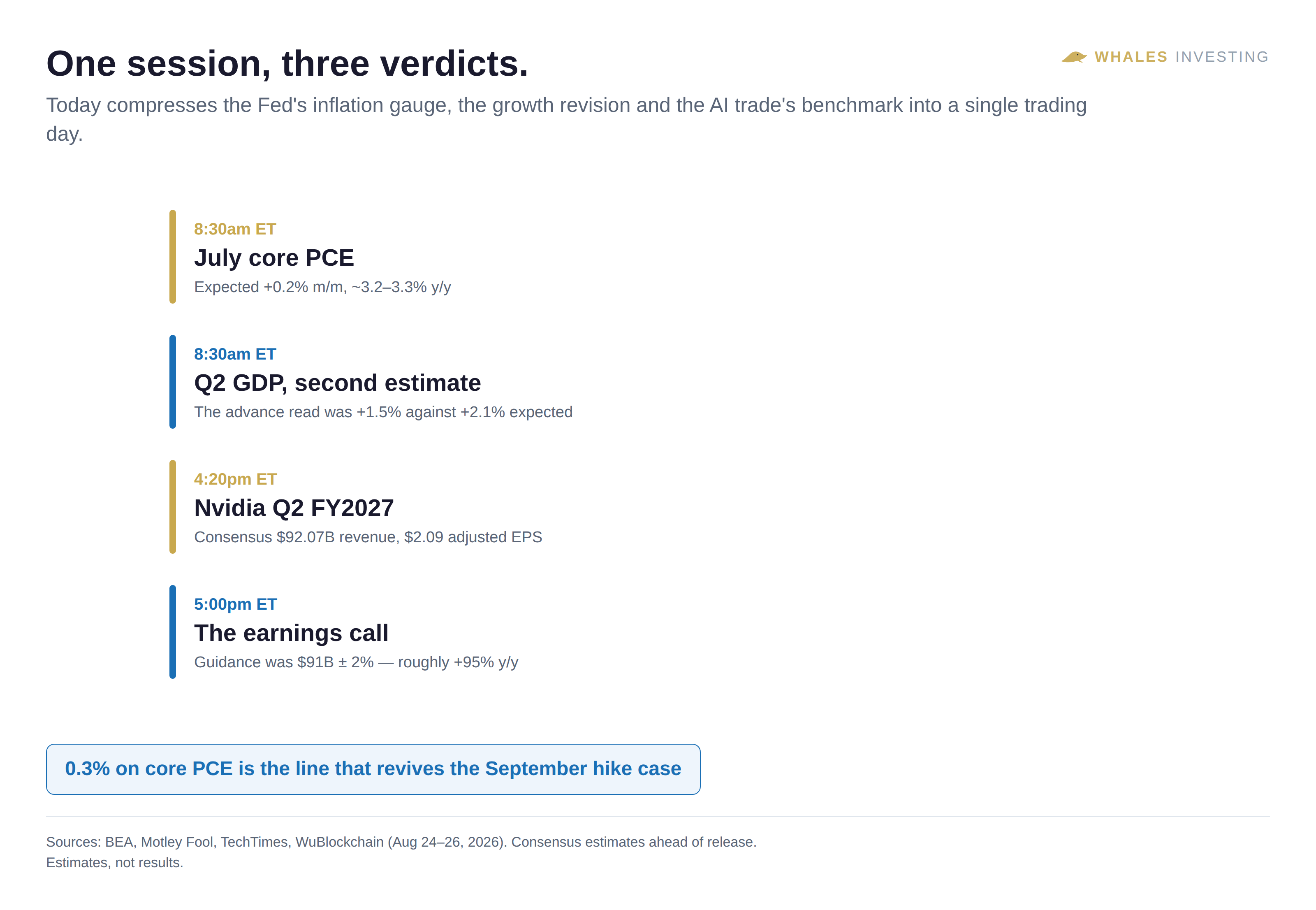
The same 8:30 window brings the second estimate of Q2 GDP. The advance reading was +1.5% annualised against +2.1% expected — a meaningful miss that got very little attention at the time. And at 4:20pm, Nvidia reports Q2 FY2027, with the call at 5:00. Guidance issued in May was $91B ±2%. Consensus sits at $92.07B revenue and $2.09 adjusted EPS, against $1.05 a year ago — roughly +95% y/y growth. The stock went into the print on seven consecutive down sessions.
One more thing sits in the background of this week that almost nobody is discussing. The Bureau of Labor Statistics is due to reassess payroll growth through March 2026 using broader administrative records — a benchmark revision. If that comes back materially lower, it retroactively changes the picture of how strong the labour market actually was during the period the Fed was making decisions about it. Revisions of that kind don’t move markets on the day. They change what everyone believes the last twelve months meant.
What makes today genuinely different from a normal data day is the subject matter. One release measures whether the currency is holding its value. The other measures whether the technology that is currently reorganising white-collar work can keep funding itself. Those are the two questions that actually determine what the next decade looks like for anyone with savings — and the first item on my desk this morning takes up exactly that pairing.
SPONSORED
Editor's note: Life in America is about to take a very strange turn, says one of Wall Street's best-connected millionaires, who called the 2000 and 2008 crises, all while building his own $200 million hedge fund firm.
At Harvard, Whitney Tilson became close friends with billionaire hedge-fund manager Bill Ackman...
He took on radical socialist New York City mayoral candidate Zohran Mamdani in a public debate last year...
He accurately forecast the 2000 tech wreck and starred in an Emmy-winning 60 Minutes episode on the 2008 financial crisis...
And he's one of the best-connected insiders in America today, with dozens of millionaire and billionaire friends. (He even bakes cookies for Warren Buffett at Christmas.)
I'm telling you this today because Tilson says the next six months are going to be a time of extreme change in our country.
He's warning that America is in the early stages of a crisis that no one in our country can avoid.
It's connected to the huge (and rapid) changes we've seen as a result of AI and other radical new technology.
But Tilson isn't merely warning of more job losses, or another big selloff in the stock market (though he says both of those things are highly likely in the near future).
He says we're living through a permanent reset that'll destroy the America you grew up in.
"I'm 59. I'm a father. And what's coming in America's near future keeps me awake at night, frankly," he said.
That's why he's stepping forward publicly today.
If he's right, 2026 will be a year like no other – and it's crucial you prepare.
In fact, there are several things Tilson recommends you do immediately to get ready. (Step #1 alone could make you more than stocks, bonds, and even gold.)
I strongly encourage you to take a few minutes to hear Tilson's latest prediction.
We've posted everything you need to know on our website, free of charge. Everything you need to know is right here.
Regards,
Matt Weinschenk
Publisher and Director of Research, Stansberry Research
By the Numbers
The rate the Fed doesn’t set
While everyone watches the 8:30 print, the more revealing number this week sits at the far end of the curve. The 2-year yields 4.244% — that one tracks Fed expectations. The 10-year sits at 4.715%. The 30-year is at 5.243%, hovering around its highest in ~20 years.
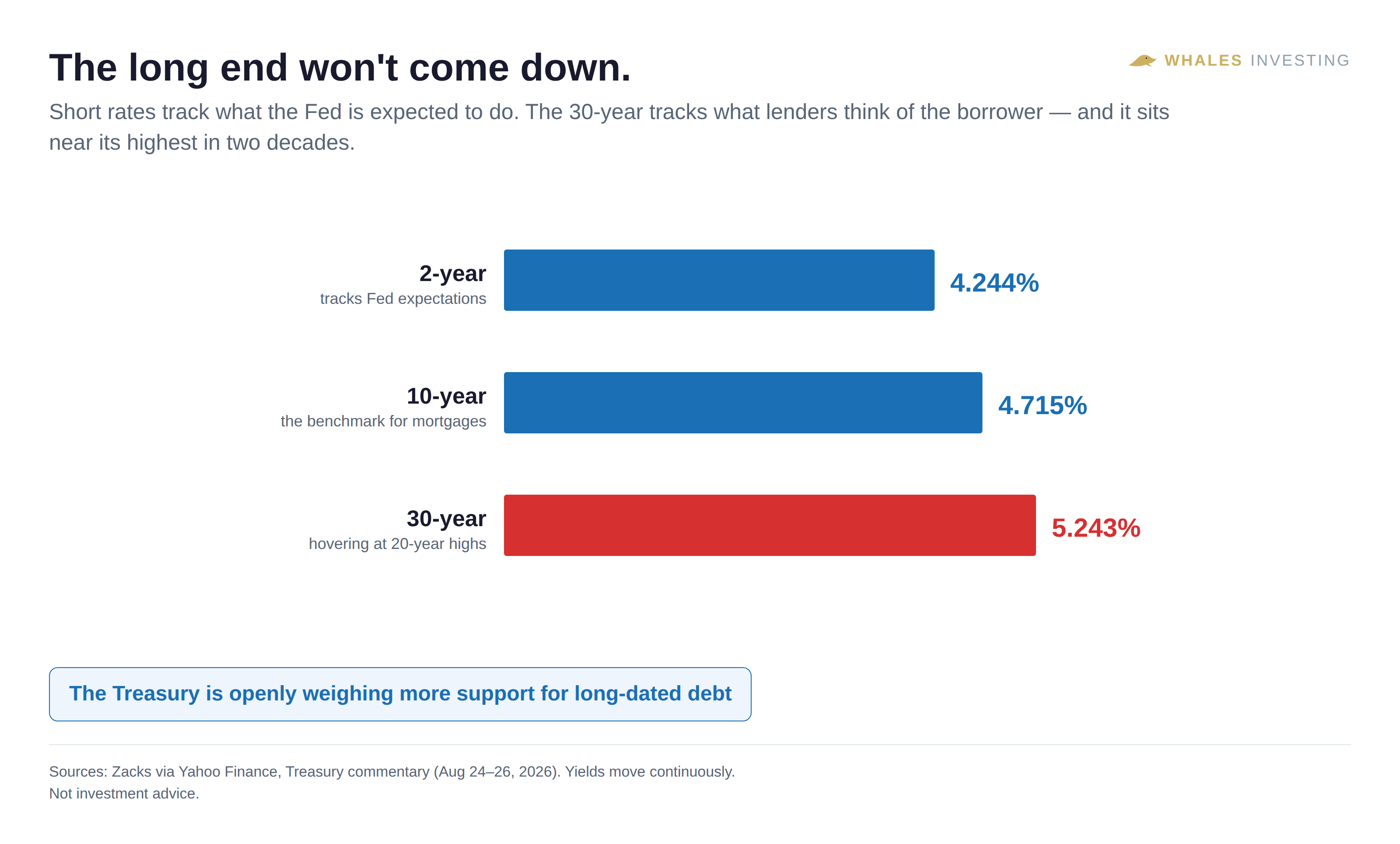
That distinction is the whole point. Short-dated yields move on what the Fed is expected to do next month. The 30-year moves on what lenders think of the borrower over three decades — the debt load, the deficit path, the willingness to inflate. Markets have spent the month cutting September hike odds from ~50% to ~31%, and the long end has gone the other way regardless. That is a bond market saying rate policy is not the variable it is worried about.
It is worth being precise about why the long end matters more to a saver than the headline rate does. The 30-year is the price of patience — what someone must be paid to lend for three decades and be repaid in future dollars. When that yield climbs while short rates are expected to fall, lenders are not saying “the economy is hot.” They are saying they want more compensation for the risk that those future dollars buy less. That is the same message gold has been sending, expressed in a different instrument.
Treasury Secretary Bessent has been openly discussing doubling liquidity support for long-dated bonds — buying more of the government’s own debt to hold that yield down. It is a legitimate liquidity tool and it is also an admission of where the pressure is.
Which brings up the other half of the fiscal picture that has been circulating since last year: what happens to tariff revenue. The administration has publicly floated returning some of it to households directly, and the idea keeps resurfacing in different forms — a rebate, a dividend, a check. Whether any version becomes law is a separate question from why it keeps coming back, and the second item on my desk today runs with that theme.
SPONSORED

Did you claim your $2,000 tariff dividend from Trump yet?!
Because it's not just a payout it's the first sign of a massive wealth shift already in motion.
Trump's calling it a Restoration Dividend.
Others say it's "America's next great reset."
Here's the truth:
This isn't about charity, it's about taking control back.
Your savings. Your retirement. Your freedom.
The first checks are just the beginning.
The real opportunity? Is what comes next.
The Other Angle
The conflict discount arrived. The power bill didn’t.
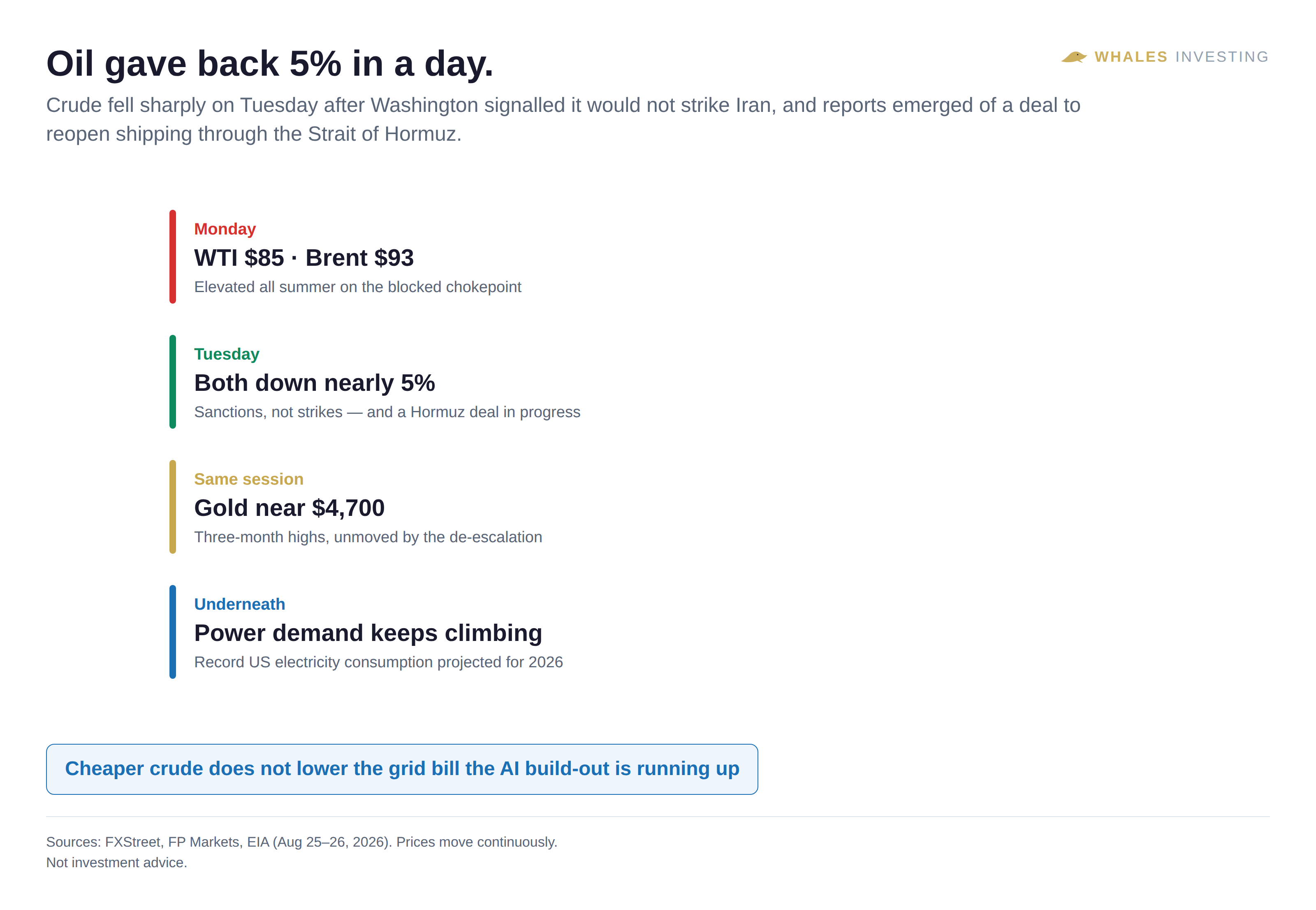
Oil moved hard yesterday. WTI and Brent both shed nearly 5% after Secretary of State Rubio said the US will not initiate strikes on Iran, with the focus on economic sanctions instead — and after reports that Iran and Oman are closing on a deal to facilitate flows through the Strait of Hormuz. Crude had been sitting at $85 WTI and $93 Brent on Monday.
Gold barely noticed. It continues to trade near three-month highs just shy of $4,700. Two markets received the same de-escalation news and only one of them acted on it — which tells you what each is actually pricing. Oil was pricing a shipping lane. Gold is pricing something else.
There is a useful test in that divergence for reading any headline this autumn. Ask which market had the most to lose if the story were true, and whether it actually moved. Crude had everything riding on the strait, so it repriced instantly on the first credible sign of a deal. Gold had nothing riding on the strait — its bid comes from currency and reserve behaviour, which no ceasefire touches. Same news, two different questions being answered.
And here is the part cheaper crude does not solve. The constraint on the AI build-out is not the price of a barrel — it is electricity. Wholesale power near major data-centre hubs has risen by as much as 267% since 2020. The largest US grid operator ran a capacity auction that cleared at record prices and still failed to procure enough capacity for its own reliability targets. The Energy Information Administration projects record American electricity consumption in 2026. Nvidia’s numbers tonight describe demand for chips; the harder question is what runs them, and that is where the last item on my desk today points.
SPONSORED
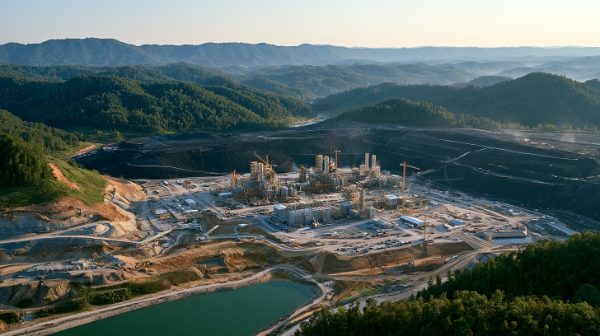
Drone footage over Mason County, West Virginia just captured something nobody expected.
Right next to America's largest coal reserves, a brand-new $850 million facility is rising.
But if you look closely at the site plans, something vital is completely missing.
There are no smokestacks. No smoke. No emissions.
Engineers are using a patented technology that doesn't burn a single chunk of coal.
Instead, this zero-waste process "splits" raw coal into pure hydrogen, jet fuel, and diesel right on the spot.
While Wall Street assumed coal was dead, this single facility is targeting a $2.1 trillion energy boom.
And everyday Americans are quietly positioning themselves before this technology goes public on NASDAQ.
Click here to see the West Virginia facility footage and details now.
This is a paid advertisement for Frontieras’s Regulation A offering. Please read the offering circular at
https://invest.frontieras.com/
Reservation of the ticker symbol is not a guarantee that we will be listed on the NASDAQ. Listing on the NASDAQ is subject to approvals.
Under Regulation A, a company may change its share price by up to 20% without requalifying the offering with the Securities and Exchange Commission.
Sources* The global market for our products is worth a combined value of over $2.1 trillion
GlobeNewsWire.com - Business Outlook and Forecast 2027
MarketsAndMarkets.com - Hydrogen Market Size, Share & Trends
TransparencyMarketResearch.com - Naphtha Market
FortuneBusinessInsights.com - Aviation Fuel Market Size and Industry Overview
MarketResearchFuture.com - Anthracite Market Summary
PrecedenceResearch.com - What is the Fertilizer Market Size?
Oil dropped ~5% on peace headlines and gold didn’t move at all. When two markets get the same news and only one reacts, the one that stayed still is telling you it was never trading that story.

The Bottom Line
Two numbers, opposite directions of risk
Core PCE at 8:30 is an asymmetric event. A soft print confirms what the market has already priced — hike odds near ~31%, the Fed comfortable holding — so the reaction is likely muted. A print at 0.3% or above contradicts positioning that has moved decisively one way, which means the surprise lands almost entirely on one side. That is the risk worth respecting: not the expected outcome, but the one nobody is arranged for.
Nvidia at 4:20pm is asymmetric in the other direction. Expectations are $92.07B and ~+95% growth, guidance was $91B ±2%, and the stock arrives on seven straight down days. When a company must deliver near-perfection just to meet the bar, the distribution of outcomes skews toward disappointment even when the business is performing. The number I’d read first is not revenue — it’s what management says about margins, because memory and power costs are climbing into the same quarters they’re guiding.
And underneath both, the 30-year at 5.243% keeps saying the same thing it has said all month: the market’s concern is not this September’s rate decision. It’s the arithmetic of the borrower over the next thirty years, and no single data release changes that.
Protect first. Position for the regime you’re actually in, and watch which markets ignore the news rather than which ones react to it — because the asset that stays still through a headline was never trading that headline. Because the capital you keep is the only capital that compounds.
— Hawk