
🐋 WARNING: Official Buyers Now Own 24% of the Gold Market
In 2022 It Was 10%. That Shift Is Doing More Than Any Forecast.


Desmond Hawk | August 25, 2026
The Setup
A record, a 28% drawdown, and a recovery — all in eight months
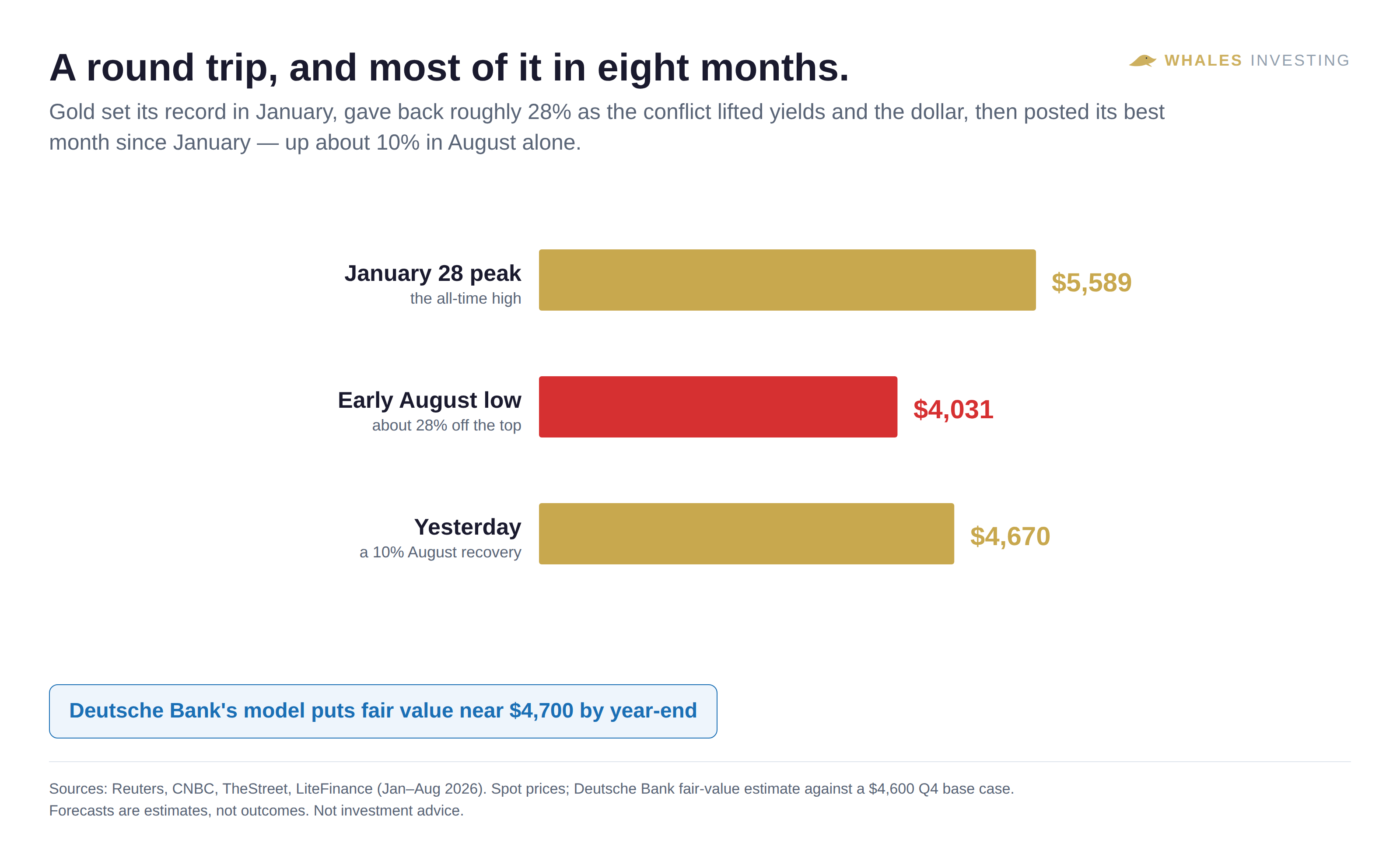
Gold traded near $4,670 yesterday, and getting there has been anything but a straight line. The metal set its all-time high of $5,589 an ounce on January 28. Then the conflict in the Middle East pushed yields and the dollar higher, and gold gave back roughly 28%, bottoming near $4,031 in early August. Since then it has climbed about 10% in a month — its best since January.
The mechanism behind August’s move is simple enough to state precisely. Gold pays no yield, so it competes against what cash and bonds pay after inflation. Three data prints in one week — jobs, consumer prices and producer prices — all came in soft, and the market’s odds of a September rate increase fell from around 50% to 31. Lower expected real yields make a non-yielding asset relatively more attractive, and the metal moved accordingly.
Worth noting how unusual that drawdown was in context. A 28% decline would normally end a bull market conversation entirely. Instead the metal is back within about 16% of its record after a single strong month, which tells you the selling was driven by rate and dollar mechanics rather than by anyone abandoning the underlying case.
The forecasting community has been whipsawed by that round trip, which is worth knowing before reading anyone’s target. Several major houses cut their numbers during the summer drawdown: JPMorgan moved to a fourth-quarter target of $4,500, Bank of America trimmed its 2026 average by 14%, ING lowered its fourth-quarter figure from $5,000. Others went the other way — Standard Chartered raised its Q4 average to $4,650. Deutsche Bank’s model puts fair value near $4,700 by year-end against a more conservative $4,600 base case, and its analysts describe the period since August 2024 as an “explosive phase,” something they say has occurred only four other times since 1975. Those are estimates from people whose estimates have moved a lot this year, and the longer-dated ones are the subject of the first item on my desk today.
SPONSORED

One of the world’s biggest banks just ran the numbers on gold for the next five years.
Hint…the findings weren’t small.
Deutsche Bank’s research team just published a target most American retirees will never see in their newspaper.
$8,000 per ounce. By 2031.
That’s roughly 80% higher than where gold trades today.
And the analysts didn’t pull the number out of a hat. They ran a unique model — a “what-if” test asking this:
If the world’s biggest governments keep moving their money out of U.S. dollars and into gold at the same pace they’ve been moving it, where does gold end up in five years?
The answer came back: $8,000.
In their own words:
“Gold is poised to benefit significantly from an increasingly fragmented world as nations continue to pivot into the metal and away from the U.S. dollar as their go-to reserve asset.”
This isn’t a fringe call. Other major banks are saying similar things for the near term:
- JPMorgan: $6,000/oz by the end of this year
- Goldman Sachs: $5,400/oz
- UBS: $5,900/oz by late 2026
Three of the largest banks on Wall Street already expect gold above $5,000 within near months to come. Deutsche Bank is just looking five more years out.
Here’s what matters for American retirees.
(spoiler alert…we put together THIS free Wealth Protection Guide with everything already outlined)
If most of your savings sit in dollars — bonds, mutual funds, cash, 401(k) accounts — you may be on the wrong side of a move the world’s largest central banks are already making.
Inside the free Wealth Protection Guide, you’ll find what most retirees miss about positioning before — not after — a move like this plays out.
By the Numbers
The buyers who ignored the drawdown
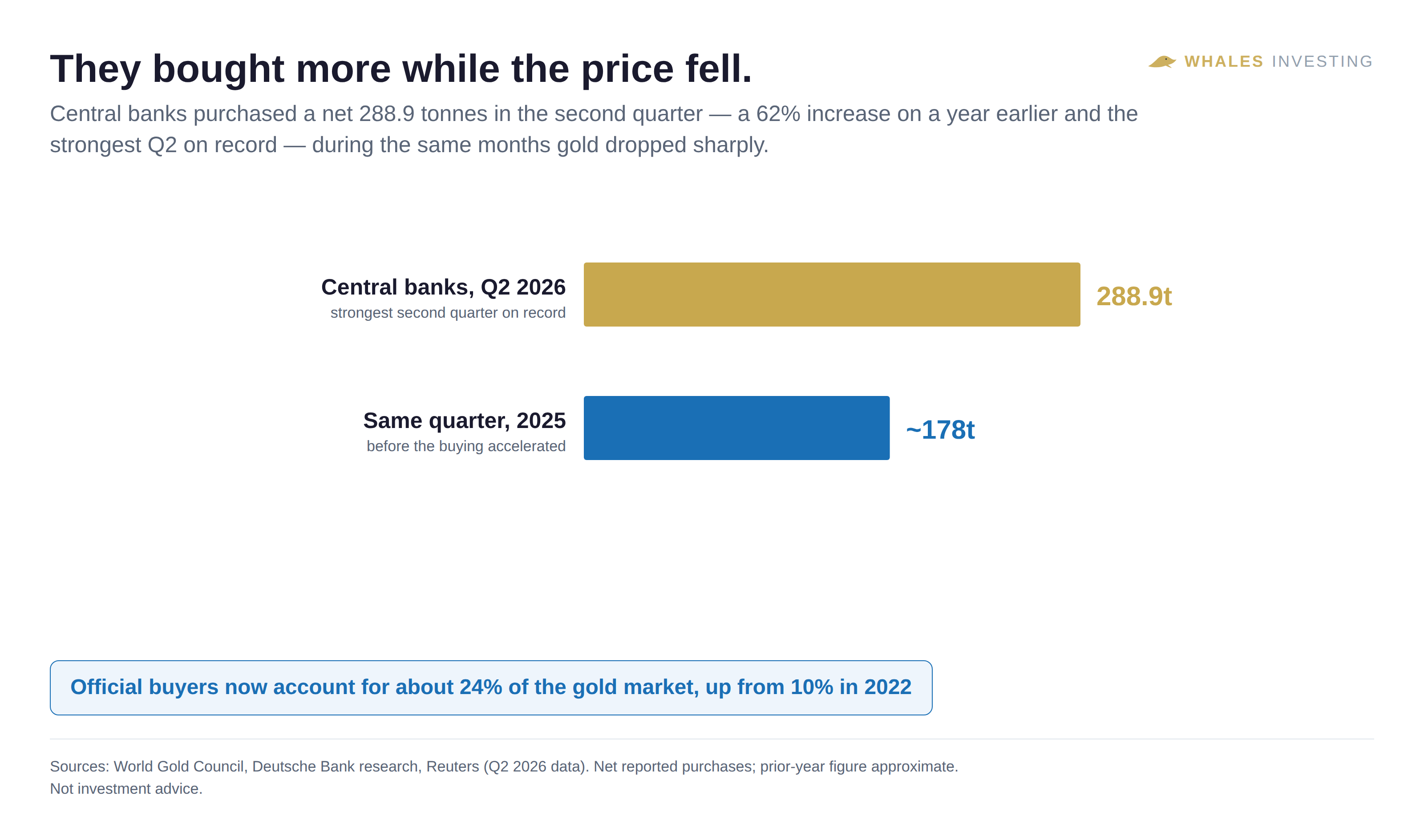
Here is the fact I find most instructive about this year, and it has nothing to do with anyone’s price target. During the second quarter — the same months gold was falling hard from its January record — central banks bought a net 288.9 tonnes. That is a 62% increase on the same quarter a year earlier, and the strongest second quarter on record.
Read that sequence carefully, because it inverts how most people think about markets. Prices fell and the largest, best-informed, least emotional buyers in the market increased their purchases by nearly two-thirds. They were not trading a chart. They were executing a reserve policy, and a falling price simply made the policy cheaper to execute.
The scale of that shift is easy to underestimate. Deutsche Bank’s own research notes that central bank demand has expanded from roughly 10% of the gold market in 2022 to about 24% today. The World Gold Council’s survey found that 95% of central banks — the highest share it has ever recorded — expect global gold reserves to increase over the next twelve months. Meanwhile above-ground supply has grown at only around 2% a year this century. A structural buyer taking a quarter of a market whose supply barely moves is a different kind of force than a rally.
There is a second-order effect here that rarely gets discussed. When an official buyer takes a quarter of annual demand and does not sell, that metal leaves the tradeable float permanently — reserves are not a position anyone trades around. Each record quarter therefore tightens the supply available to everyone else, which is a slower and more durable influence on price than any flow of investor sentiment. It is also why the drawdown and the buying could coexist without contradiction: one was measured in months, the other in decades.
What draws households to the same asset is usually a different concern than reserve policy. It is the fact that metal held directly sits outside the reporting architecture that governs almost everything else — brokerage statements, bank interest, property transfers — and that it passes between generations without the paperwork those instruments require. Whether that suits any particular family depends entirely on their tax position and their heirs, and that is the question the second item on my desk addresses.
SPONSORED
The IRS Loves When You Pass Down Cash
Here's the Asset Used to Hand Down Wealth
Privately

When most people think about leaving something behind for their kids or grandkids, they default to cash, stocks, or real estate.
The problem?
Every one of those inheritances leaves a paper trail. Bank accounts are reported. Brokerage statements are tracked. Real estate transfers require government paperwork.
The IRS loves it. Easy to track, easy to tax.
But there's one inheritance asset that works differently: physical gold.
Unlike stocks or cash in the bank, gold coins don't generate automatic IRS forms.
When you buy popular coins like American Gold Eagles and store them at home or in a private vault, they sit outside the banking system.
That's why many families are turning to gold. It's private, durable, and completely under your control.
What most people don't realize is that you don't need a separate stash of cash to do it.
You can use the retirement savings you already have — in a 401(k), IRA, or TSP — to buy real gold coins and bars.
And if you're 59½ or older, this purchase is completely tax-deferred and penalty-free.
Once you retire, you even have the option to take delivery of those metals right to your home.
That means passing wealth to your heirs can be as simple as handing it to them directly. No middlemen, no forms, no red tape.
With gold already up 51% in the last year and J.P. Morgan forecasting $6,000/oz within two years, now may be the smartest time to move.
That's why we've created a free Retirement-to-Gold Guide that explains:
✅ The IRS-approved way to buy physical gold with your retirement account
✅ Why gold demand is exploding in 2025
✅ How gold can be one of the simplest, most private assets to pass down to your heirs

Click below to get your free copy now:
The Other Angle
Tomorrow morning decides the next leg
All of August’s move rests on one assumption: that expected real yields keep falling. That assumption gets audited tomorrow at 8:30, when core PCE for July arrives carrying last month’s hidden acceleration in producer costs — the 0.4% jump in the measure excluding food, energy and trade services, four times June’s pace. Hours later Nvidia reports, and on Friday Kevin Warsh delivers his first Jackson Hole keynote as chair. Today brings consumer confidence for August and July new home sales.
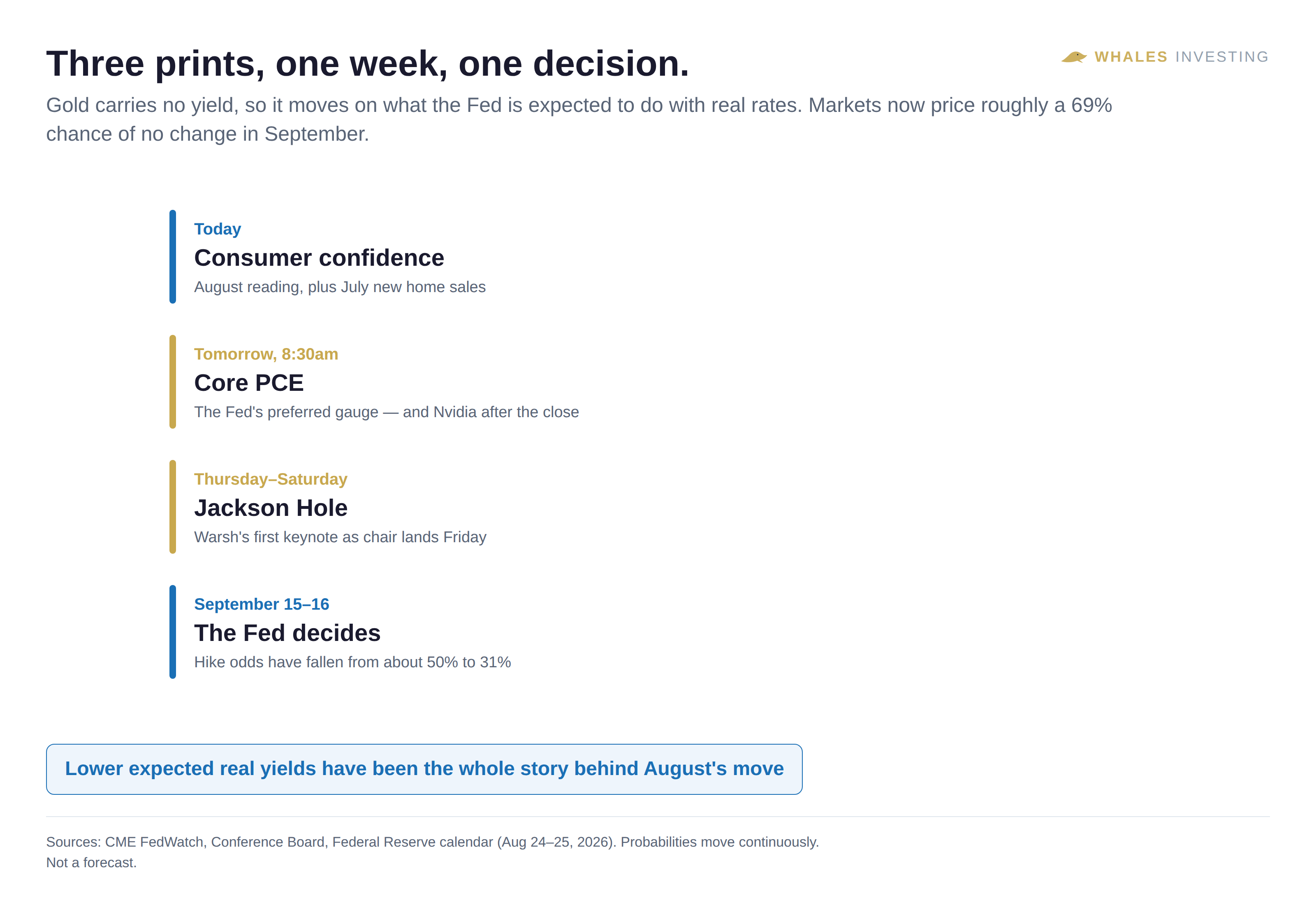
If that inflation reading confirms the pipeline pressure stayed upstream, the hold case for September firms up and the metal keeps its tailwind. If prices followed costs to the consumer, the three officials who wanted a hike in July get their evidence, real yield expectations rise, and gold loses the thing that has been driving it all month. The market currently assigns roughly 69% to no change and 31 to an increase.
Keep one asymmetry in mind while waiting for it. A soft reading confirms what the market has already priced, so the reaction is likely to be modest — the good news is largely in. A hot reading contradicts a positioning that has moved decisively toward “no change,” which means the surprise, if it comes, lands almost entirely on one side. That is usually the shape of risk worth respecting: not the outcome you expect, but the one nobody is arranged for.
There is one more variable that no forecast captures, and it has nothing to do with price. An asset’s usefulness depends not only on what it is worth but on the conditions under which you can reach it. Payment systems everywhere have been rebuilt over the past few years into infrastructure that is instant, traceable and — in principle — programmable, which is why questions about access and control now sit alongside questions about return. The final item on my desk today takes up that side of it.
SPONSORED

In a few short months, the US government could make a sweeping change to bank accounts nationwide.
It will give them unprecedented powers to control your bank account.
They could closely track every transaction... even freeze it.
Fortunately, there are 4 simple steps you can take today that could safeguard your savings.
The price fell 28% and the largest official buyers in the world increased their purchases by 62% into it. When those two facts sit side by side, one of them is describing sentiment and the other is describing policy.

The Bottom Line
Separate the forecast from the flow
There are two completely different things being discussed whenever gold comes up, and they get blurred constantly. One is the price forecast — a number produced by a model, revised often, and this year revised in both directions by nearly every major bank. Several cut their targets sharply during the summer drawdown and have not fully restored them. Treat any specific figure, from any source, as an estimate with a track record you can check.
The other is the flow, and that has been remarkably consistent. Official buyers took a record second quarter into a falling price, their share of the market has more than doubled since 2022, and the overwhelming majority say they intend to keep going. That is not a prediction; it is reported behaviour by the institutions with the clearest view of currency risk, because they are the ones issuing the currency.
For the near term, none of it outweighs tomorrow morning. Core PCE sets real yield expectations, and real yields set the price of an asset that pays nothing. A soft print extends August’s move; a hot one ends it and hands the July dissenters their argument back three weeks before the Fed meets.
Protect first. Position for the regime you’re actually in, and weigh what large holders are doing more heavily than what analysts are saying — because behaviour gets revised far less often than a target does. Because the capital you keep is the only capital that compounds.
— Hawk