🐋 The Market Just Split the Giants in Two
Microsoft soared. Meta sank. Same evening, same industry, opposite verdicts.

Desmond Hawk | July 30, 2026
Yesterday delivered the answer the whole week was building toward, and it was sharper than anyone expected. The Federal Reserve held rates. Then, after the close, Microsoft and Meta reported — and the market did something it hasn’t done in two years. It told them apart.
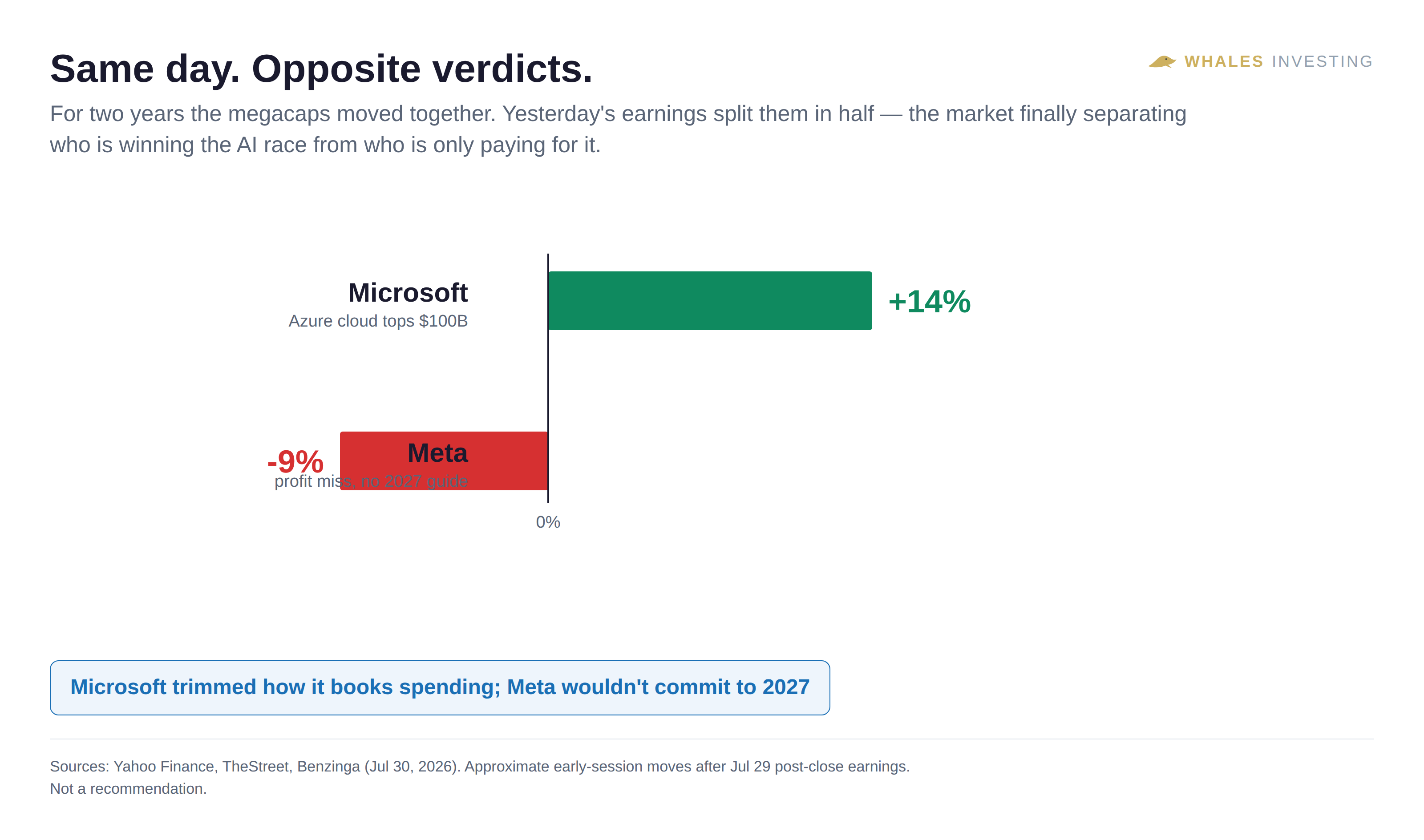
Microsoft jumped as much as 14 percent. Meta fell around 9 percent. Two companies of similar size, in the same business, spending similar fortunes on artificial intelligence, moving violently in opposite directions on the same night. That divergence is the most important thing that has happened in this market all month, and it changes how you should read everything still coming — starting with Apple and Amazon tonight. Let me walk through it.
One. The split that ended the herd
For two years the megacaps traded as a single organism. Good news lifted all of them; fear sank all of them. That era appears to have ended in a single evening.
Microsoft rose because its Azure cloud business topped $100 billion in annual revenue for the first time, and — crucially — because management showed spending discipline, extending the useful life of some data centres to move costs out of capital spending. Meta fell because it missed on profit, declined to give any capital-spending guidance for 2027, and watched its cash pile shrink while its AI bill climbed. Same sector, same AI thesis, opposite reactions.
This is what a maturing theme looks like. Early on, a whole sector rises together on a story. Later, the market starts demanding proof — and begins sorting the companies that are turning AI spending into revenue from the ones still writing cheques and hoping. That sorting is exactly the pitch behind the first promotion on my desk this week.
SPONSORED
Holding mediocre stocks used to mean missing out on better gains.
In today’s market, holding the wrong companies is actively destroying hard-earned savings.
As artificial intelligence restructures the economy, popular household stocks are quietly losing their edge — including high-profile EV makers burning $2 billion in cash a year and overvalued software firms.
That’s why former hedge fund manager Whitney Tilson and his team analyzed 5,300 traded securities using an advanced algorithmic engine called The N.E.W. System.
The results yielded two urgent research briefs:
- Ripping Point Riches: The 7 top-scoring companies positioned to dominate the new economy.
- Ripping Point Casualties: The 7 lowest-scoring stocks that millions of Americans own in their retirement accounts right now, but need to exit immediately.
You don’t need to pay thousands of dollars in Wall Street hedge fund fees to see these names.
For a limited time, you can access both research briefings and test drive the entire scoring platform risk-free for 30 days.
Claim your risk-free offer to access the 7 Top Stocks to Buy and 7 to Sell right here.
Selling the wrong stock at the right time can protect your financial future far more than picking ten average winners.
The one idea here worth keeping is genuinely sound and rarely stated: knowing what to sell matters as much as knowing what to buy. The rest — a proprietary “system,” seven names to dump “immediately,” a countdown on a free trial — is the packaging that sells a subscription. No algorithm can tell you which stock drops nine percent after hours; last night proved that even the professionals were split. Use the reminder, skip the urgency.
Two. The Fed held — but three of them wanted a hike
Before the earnings, the decision. The Fed left rates unchanged at 3.50 to 3.75 percent, a fifth straight hold — but the vote was 9 to 3, with three policymakers wanting a quarter-point hike. That dissent matters more than the hold.
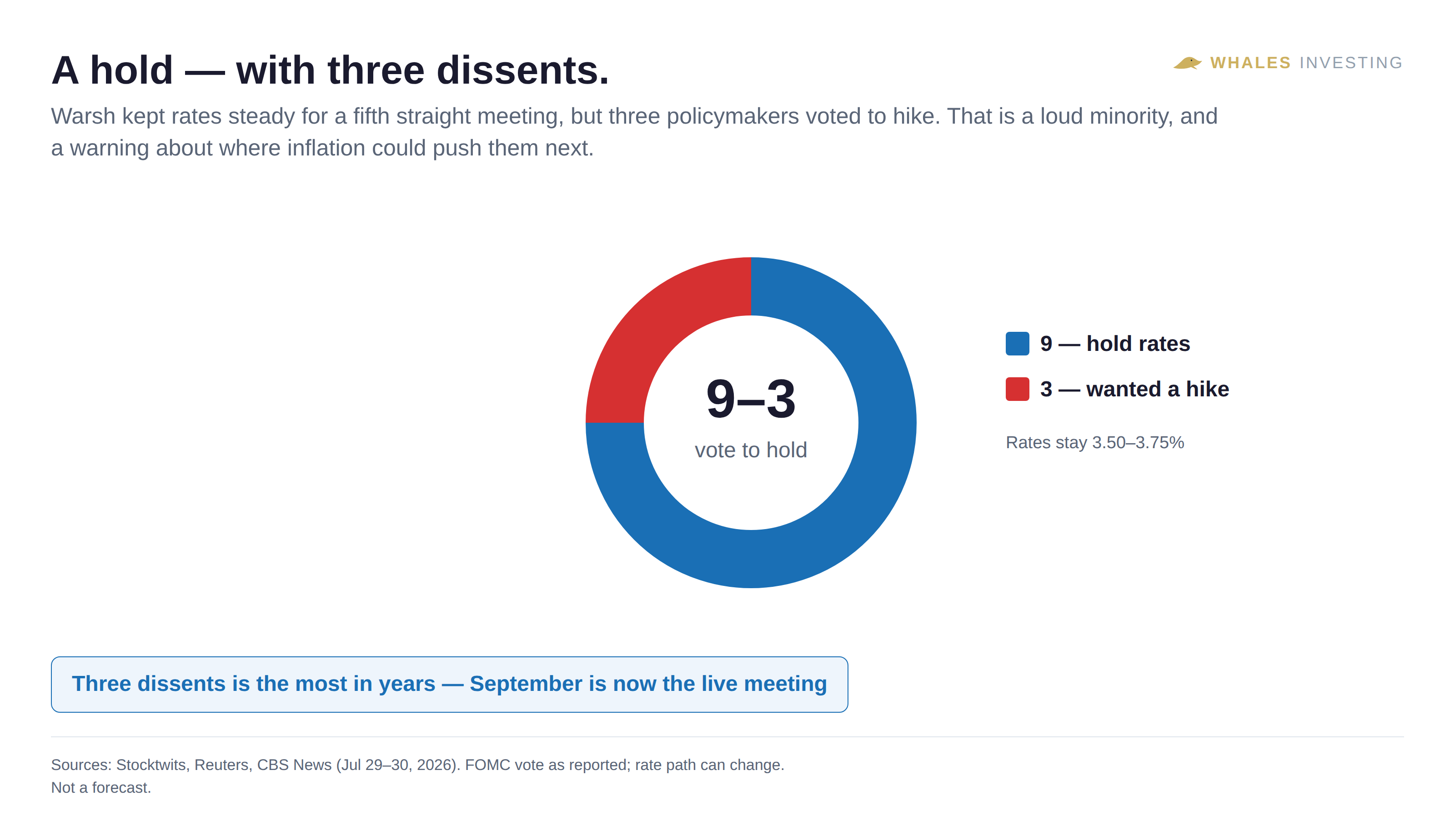
Three dissents is a lot. It tells you a meaningful bloc inside the Fed is now uncomfortable enough about inflation to want to act, which makes September a genuinely live meeting rather than a formality. Kevin Warsh, sticking to his no-guidance style, gave little away about where he personally stands — but the market got the message anyway. The initial reaction was ugly: the Dow fell around 800 points on the decision, before Microsoft’s earnings rescued the mood overnight. That anxiety about a heavier hand from Washington is what the second promotion this week is built to sell.
SPONSORED
In a few short months, the US government could make a sweeping change to bank accounts nationwide.
It will give them unprecedented powers to control your bank account.
They could closely track every transaction... even freeze it.
Fortunately, there are 4 simple steps you can take today that could safeguard your savings.
Discover these 4 simple steps here.
Good luck and God bless!
The debate over greater government visibility into payments is a real policy conversation, worth following on its own terms. But “they could freeze your account” and “four simple steps” turn a slow, contested question into an emergency with a tidy solution — and the solution, predictably, sits behind the link. I won’t lend that framing my own voice. Follow the policy; treat the alarm as a sales device.
Three. The oil war reignites underneath it all
While the market obsessed over earnings, the geopolitical floor shifted again. Iran launched a fresh attack on U.S. military positions in the Middle East, ending the fragile pause for good, and Brent crude sits back near $87 — roughly $15 above where it stood before the fighting began.
This is the piece that keeps the Fed’s three dissenters relevant. As long as energy can spike on a headline, the inflation risk those policymakers are worried about stays real, and the path to rate cuts stays blocked. I’ll keep the geopolitics brief, as I always do — people are living through this, and it deserves better than a trading angle. The relevant financial fact is simply that oil hasn’t settled, and neither has the inflation question riding on it. The wish for income that doesn’t depend on any of this is what the last promotion this week runs on.
SPONSORED
There are two possible paths to Universal Basic Income (UBI) in America.
Path #1: Wait for Elon Musk’s robots to take over the economy, hope the government figures out how to redistribute AI-generated wealth, and pray it happens before you’re 90.
Path #2: Enroll in what I call the Patriot Income Plan (P.I.P.) and start collecting 10% a year from America’s oil and gas infrastructure immediately.
42 payouts a year. Deposited automatically into your account.
Enrollment is easy. All you need is a photo ID, bank account, social security number, and permanent address. That’s it.
One P.I.P. investor collects $4,800 a month. Another pulls in $25,000.
A guy named Weston says he collects $350,000 a year.
I can’t verify these claims since they’re from the wild west of the Internet.
But I don’t doubt them either.
Musk has been tweeting about UBI for a decade. These investors have been collecting it.
The next P.I.P. payout is already on the calendar.
P.S. Since 2020, the average partnership in P.I.P. has produced 20% avg. annual gains. That’s in addition to the 10% yield. One investor already collects $4,800 a month. Another hasn’t worked in years. Show me something better. I’ll wait.
Credit where due: this one openly admits it can’t verify its own numbers, which is more honesty than most. What’s behind the “Patriot Income Plan” language is almost certainly ordinary energy-infrastructure partnerships — a real asset class that does pay high income, and also carries real tax complexity and real risk of a distribution cut. A $350,000-a-year anecdote is not a plan. The underlying idea — owning income-producing assets — is sound; the numbers wrapped around it are advertising.
Four. And tonight, the last two report
The week isn’t finished. After the close today, Apple and Amazon — the other two of the four megacaps due this week — deliver their results. For Amazon, the focus is its cloud margins and how much it’s spending on AI. For Apple, it’s whether a memory-chip shortage is squeezing the profit it makes on each device.
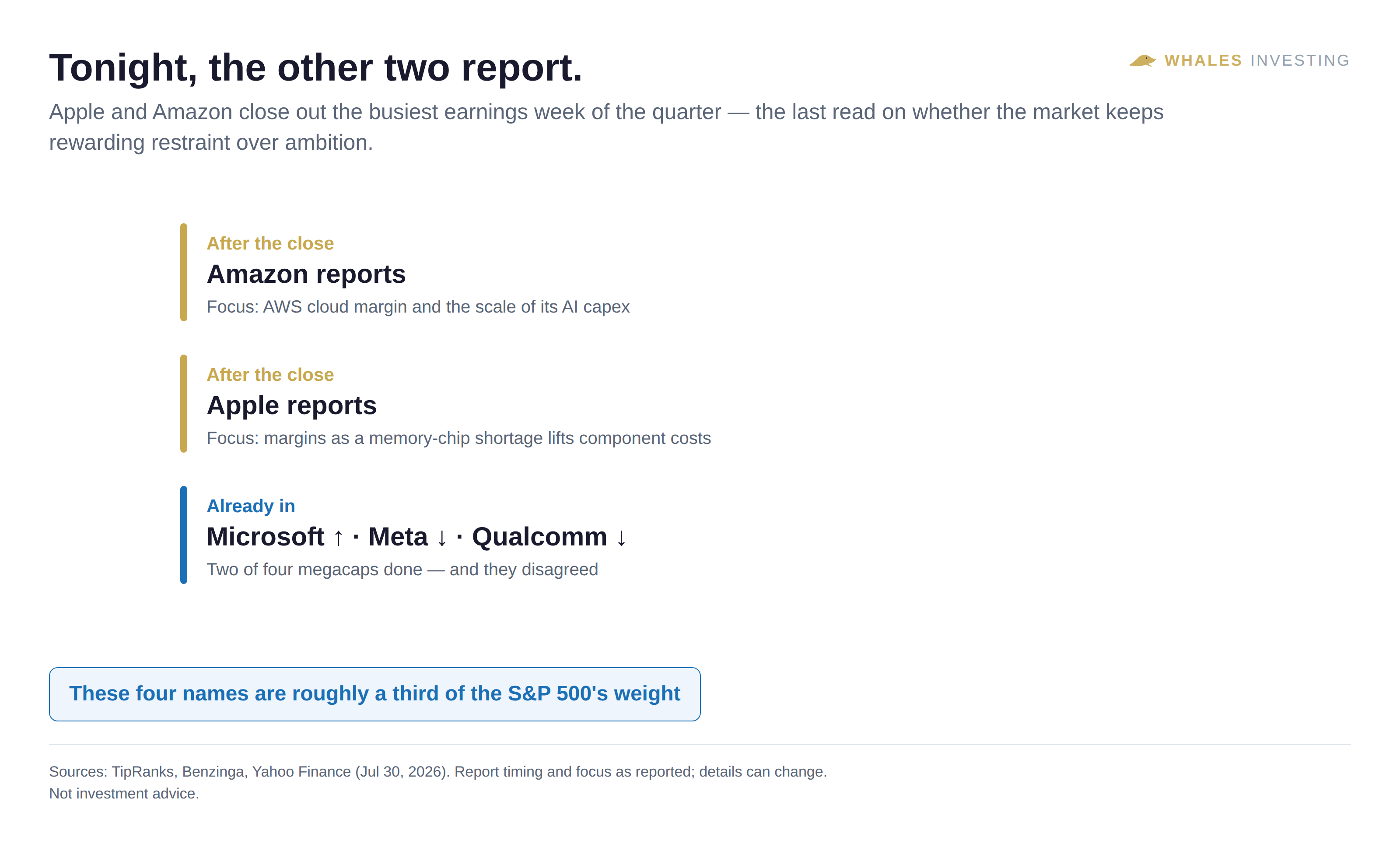
After last night, the test for both is clear. The market has just shown it will reward discipline and punish open-ended spending, even from the biggest names on earth. Apple and Amazon report into that freshly harsh standard — and together these four companies are worth roughly a third of the entire S&P 500, so how they land shapes the index far more than any single stock should.
The herd is gone. From here the market is grading these companies one at a time, on whether the spending turns into profit — and that is a far healthier, far more dangerous market than the one that bought them all together.

Analyst's Note. Three promotions ran above — a "7 to buy, 7 to sell" system, a bank-freeze warning, and an oil-income plan. Each borrows its charge from a genuinely eventful day, and each sells something. So separate the two. What's real: Microsoft rose about 14 percent on cloud strength and spending discipline while Meta fell around 9 on a profit miss and no 2027 guidance; the Fed held at 3.50–3.75 but three officials dissented for a hike, making September live; Iran struck U.S. positions again and Brent sits near $87; and Apple and Amazon report tonight into a market that has decided a beat alone isn't enough. What's marketing: proprietary "systems," account-freeze countdowns, and six-figure income anecdotes. The signal I'd carry is the split itself — when the market stops moving the giants as a herd and starts grading them one by one, the thing that matters is no longer the story, but the proof.
The Bottom Line
This was the day the AI trade grew up. For two years the market bought the megacaps as a single bet on a single story. Last night it stopped, and started asking each of them the harder question: not “are you spending on AI,” but “is that spending coming back as profit.” Microsoft answered yes and was rewarded; Meta couldn’t, and was punished.
Underneath it, a Fed with three dissenters, an oil war that just reignited, and two more giants reporting tonight into a standard that has visibly hardened. None of it is settled, and the market is more discerning — and less forgiving — than it was a week ago.
Protect first. Position for the regime you’re actually in, and own the companies that can prove the return, not just tell the story. Because the capital you keep is the only capital that compounds.
— Hawk