
🐋 The 0.4% Buried Inside Yesterday's "Good" Inflation Report
Headline PPI Was Flat. The Number Feeding the Fed's Gauge Quadrupled.


Desmond Hawk | August 14, 2026
This was the week the data was supposed to settle the argument, and on the surface it did. Wednesday’s consumer price index rose 0.1 percent in July, putting annual inflation at 3.4 percent, down from 3.5, with core slowing to 2.5 percent — the coolest since March 2021. Thursday’s producer price index was calmer still: unchanged for the month against a forecast of plus 0.2 percent. Two soft prints after a spring of energy shocks.
The market took the invitation. The S&P 500 closed last Friday at a record 7,757.64 and has held near those levels since. The odds of a September rate hike, which sat near 50 percent midweek, drifted down to roughly 40. Gold pushed above $4,400 on Thursday before easing back near $4,350 — a ten-week high. The ten-year Treasury yield hovers around 4.6 percent. Crude has settled in the high seventies, with West Texas Intermediate near $78.72 and Brent around $84.23, well off July’s highs when the Strait of Hormuz shut and prices ran up roughly 22 percent in a month.
So that’s the story as it will be written up over the weekend: inflation is cooling, the Fed can wait, buy the dip. I want to spend this letter on the three things that story leaves out.
One. The number underneath the number
Start with Thursday’s producer price report, because the headline is genuinely misleading. Final demand prices were unchanged for the month, and up 4.7 percent over the year. Core producer prices — stripping out food and energy — rose 0.2 percent monthly and 4.2 percent annually, both easing slightly. All of that reads as relief.
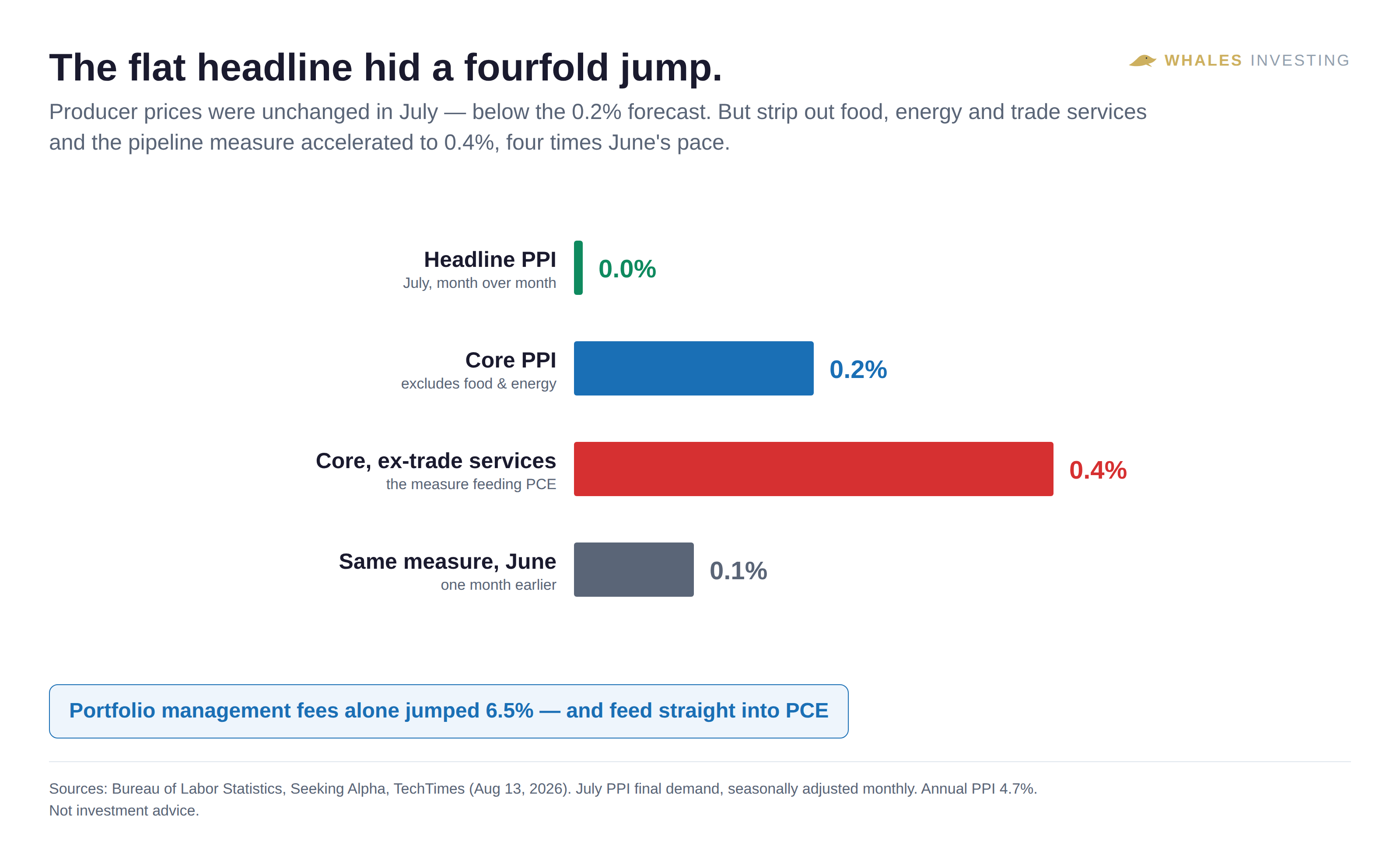
Now strip out one more thing. The Bureau of Labor Statistics also publishes a measure excluding food, energy and trade services — the cleanest read on underlying pipeline pressure. It rose 0.4 percent in July, against 0.1 in June. A fourfold acceleration in one month, inside the same report the market celebrated as soft.
Where did it come from? A 6.5 percent jump in portfolio management fees — the charges investors pay on managed assets, which rise mechanically when asset prices rise. That’s a peculiar source of inflation, and it matters more than it sounds, because portfolio management fees flow directly into the personal consumption expenditures index. Core PCE is the Fed’s preferred inflation gauge. It lands on August 26. That single line item in a report nobody read closely is now sitting in the most consequential data point before the September decision.
There’s a wider version of this pattern. Japan reported its own producer prices at 7.2 percent year over year — barely below June’s 7.3, the highest since March 2023. In the American report, goods fell 0.7 percent while services rose 0.2 and construction jumped 2.2. The average is calm. The components are not.
This is why the composition of a report matters more than its headline, and it applies to more than inflation statistics. The same logic governs the money itself. Payment infrastructure has been quietly rebuilt over the past three years — the Federal Reserve’s instant-payments service went live in 2023, and by most counts more than 130 countries, representing the overwhelming majority of global output, have studied or piloted some form of central bank digital currency. China’s digital yuan has run public trials since 2020. In the United States the direction has been contested rather than settled: as a candidate, Donald Trump said plainly he would not permit a central bank digital currency. What almost nobody disputes is that the underlying rails — instant, traceable, programmable — now exist, and that questions about who can see and control transactions are no longer hypothetical. That debate is the subject of the first item on my desk this week.
SPONSORED
Trump Warned Us: The Digital Dollar Is Coming

Back in 2024, Donald Trump stated he would never allow a Central Bank Digital Currency (CBDC) if re-elected.
Why? Because he knows exactly what it means: the government could gain total control over your money.
With a CBDC in place, the government could:
- Track every purchase you make
- Decide what you’re allowed to buy
- Freeze your accounts instantly with a click
In the wrong hands, this is the ultimate financial surveillance and control tool.
Here’s the truth: CBDC is already moving forward — fast. And if you don’t act now, you could lose your financial freedom before the next election.
👉 That’s why we’ve created a critical FREE guide showing you exactly how to legally protect your cash and privacy — starting today.
Once CBDC becomes law, opting out may be impossible. Trump is trying to stop it, but until then, it's up to you.
Get the facts. Take action. Protect your money.
Which brings me to the second thing this week’s data didn’t explain — and it’s the one I find most instructive.
Two. Governments are buying what fund investors are selling
Gold is up roughly 51 percent over the past year and trades near $4,350 an ounce. That number alone gets attention. What deserves more attention is who has been doing the buying, because the two largest groups of gold buyers moved in opposite directions last quarter.
Central banks purchased close to 289 tonnes in the second quarter — about 1.6 times what they bought in the same period a year earlier, and the fourth consecutive year of heavy official accumulation. China’s central bank added 33 tonnes, its largest quarterly purchase since late 2023. Meanwhile private investment demand fell by nearly half, to just over 262 tonnes — the lowest since the first quarter of 2024 — as exchange-traded funds shed roughly 45 tonnes.
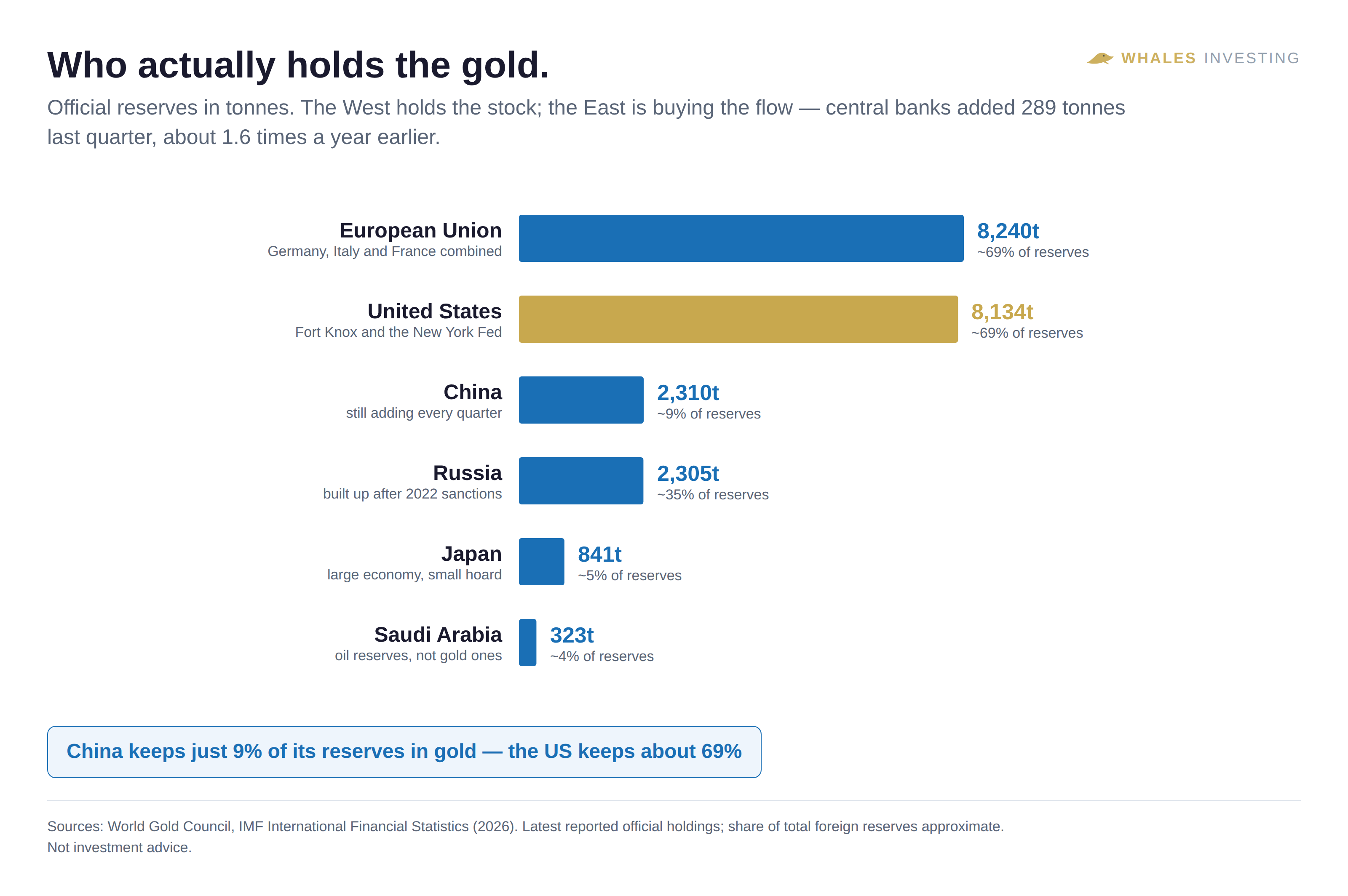
The stock of gold tells the other half of that story, and the split is geographic. The United States holds about 8,134 tonnes, most of it at Fort Knox and the New York Fed — nearly as much as Germany, Italy and France combined at roughly 8,240. China and Russia sit neck and neck near 2,300 tonnes each. Japan, the world’s third-largest economy, holds only 841. Saudi Arabia holds 323.
But tonnage alone understates what’s happening. The sharper number is what share of a country’s reserves is already in gold. For the United States and the big European holders, that figure runs near 69 percent — they are structurally committed and have been for decades. China sits at roughly 9 percent. Japan, about 5. Which means the largest buyer in the market today has enormous room left to buy, and the West has almost none left to add.
Sit with that divergence for a moment. The institutions with the most direct view of currency risk — the ones that issue currency — increased their buying by more than half again year over year. The institutions holding gold as a trade sold into the strength. Those are two very different time horizons. Central banks are not trading a chart; they are hedging the thing they themselves print. And the buying accelerated after 2022, when roughly $300 billion of Russian reserves were frozen — a demonstration that dollars held abroad sit inside someone else’s jurisdiction, and metal in your own vault does not.
There’s a household version of the same instinct, and it shows up in how families think about what they hand down rather than what they hold. Financial assets carry reporting by design: brokerage accounts generate statements, bank interest generates forms, property transfers generate filings. Physical metal behaves differently in that respect, which is one reason it keeps reappearing in estate conversations even in years when the price is doing nothing. With the metal up 51 percent over twelve months and official buying running at 1.6 times last year’s pace, that conversation has grown louder. The second item on my desk this week deals with exactly that question.
SPONSORED
The IRS Loves When You Pass Down Cash
Here's the Asset Used to Hand Down Wealth Privately

When most people think about leaving something behind for their kids or grandkids, they default to cash, stocks, or real estate.
The problem?
Every one of those inheritances leaves a paper trail. Bank accounts are reported. Brokerage statements are tracked. Real estate transfers require government paperwork.
The IRS loves it. Easy to track, easy to tax.
But there's one inheritance asset that works differently: physical gold.
Unlike stocks or cash in the bank, gold coins don't generate automatic IRS forms.
When you buy popular coins like American Gold Eagles and store them at home or in a private vault, they sit outside the banking system.
That's why many families are turning to gold. It's private, durable, and completely under your control.
What most people don't realize is that you don't need a separate stash of cash to do it.
You can use the retirement savings you already have — in a 401(k), IRA, or TSP — to buy real gold coins and bars.
And if you're 59½ or older, this purchase is completely tax-deferred and penalty-free.
Once you retire, you even have the option to take delivery of those metals right to your home.
That means passing wealth to your heirs can be as simple as handing it to them directly. No middlemen, no forms, no red tape.
With gold already up 51% in the last year and J.P. Morgan forecasting $6,000/oz within two years, now may be the smartest time to move.
That's why we've created a free Retirement-to-Gold Guide that explains:
✅ The IRS-approved way to buy physical gold with your retirement account
✅ Why gold demand is exploding in 2025
✅ How gold can be one of the simplest, most private assets to pass down to your heirs
Click below to get your free copy now:
Now the third thing, and it’s the one that reframes the whole week.
Three. The calendar the Fed watches — and the market it can’t see
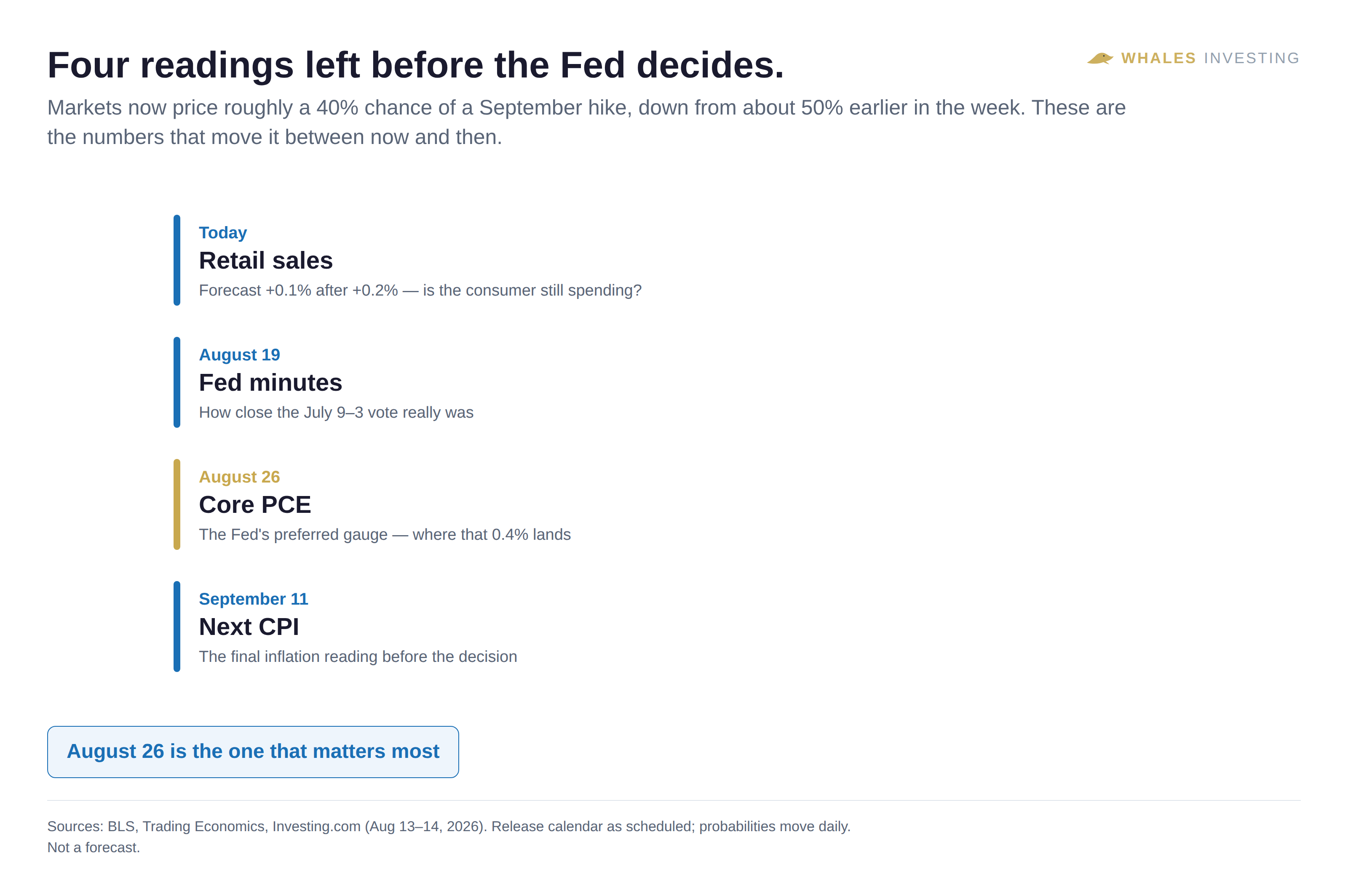
Four readings remain between today and the September decision. This morning brings retail sales, forecast at plus 0.1 percent after plus 0.2 — the test of whether households are still spending while real wages fall. On August 19 the Fed publishes minutes from the July meeting, where rates were held on a 9–3 vote with three officials pushing for an increase; the minutes will show how close that argument actually was. On August 26 comes core PCE, carrying that 0.4 percent pipeline figure. And on September 11, the final consumer price reading before the decision.
Here’s what strikes me about that list. Every one of those releases measures the visible economy — the prices, wages and spending of companies that report publicly. Yet the fastest-compounding businesses of this cycle sit almost entirely outside it. Anthropic has grown into one of the most valuable enterprises on earth without a public share price and is reported to be targeting a listing as early as October. SpaceX stayed private for roughly two decades before its June debut, and by the time ordinary investors could buy it, the first twenty years of value creation had already been distributed. The pattern is consistent: companies now stay private through the steepest part of their growth, and the public market gets the flatter part of the curve.
That’s the structural story behind a frustration I hear constantly from readers — the sense that the biggest gains happen somewhere you weren’t invited. It isn’t imagination; it’s a change in how capital formation works, and it’s the backdrop for the last item on my desk this week.
SPONSORED
Editor’s Note: Former tech executive Jeff Brown picked Bitcoin, Tesla, and Nvidia before they jumped as high as 52,400%, 2,150% and 36,000%. Now he’s recommending an Elon Musk-backed startup that has been called “the fastest-growing business in the history of capitalism.” And you can claim your pre-IPO stake for less than $50. Click here to see the details and get the name of this startup, 100% free… or read more below.
See this document below?

Elon Musk just revealed what I believe is the biggest investment opportunity of the year when he filed this official document with the SEC.
Because on page 146 he revealed the name of a startup that’s set to be…
The next monster IPO on Wall Street. (Click here to get the details.)
Even though this has nothing to do with robots, self-driving cars, or rockets…
This startup is growing faster than Tesla…
Faster than SpaceX…
And it’s even growing 23 times faster than Nvidia.
That’s why The Atlantic called it…
“The fastest-growing business in the history of capitalism.”
These types of explosive IPO opportunities are normally off-limits to everyday folks like you.
They’re reserved for rich people on Wall Street and Silicon Valley.
But I found a way for you to claim your stake before the IPO… starting for less than $50.
Two reports said inflation is cooling. A line item nobody read said pipeline costs quadrupled. Central banks bought 289 tonnes while fund investors sold. Records in stocks, ten-week highs in gold. The averages agree on calm; the components are arguing.

The Setup. July consumer prices rose 0.1 percent monthly, 3.4 percent annually, with core at 2.5 percent — the slowest since March 2021. July producer prices were unchanged monthly against a plus 0.2 percent forecast, up 4.7 percent annually; core PPI rose 0.2 percent monthly and 4.2 percent annually, but the measure excluding food, energy and trade services rose 0.4 percent, four times June’s 0.1, driven by a 6.5 percent jump in portfolio management fees that feeds core PCE on August 26. The S&P 500 sits near its record 7,757.64; the ten-year yield near 4.6 percent; gold near $4,350 after topping $4,400; WTI near $78.72 and Brent near $84.23. September hike odds have eased to roughly 40 percent from about 50. Central banks bought 289 tonnes of gold in the second quarter against roughly 45 tonnes of ETF outflows; the US holds about 8,134 tonnes to China’s 2,310, but gold is 69 percent of American reserves versus 9 percent of China’s. Retail sales land this morning, forecast plus 0.1 percent.
The Bottom Line
The week delivered exactly the reports the market wanted and left the harder questions untouched. Consumer inflation is genuinely cooling — 3.4 percent is better than 3.5, and a core reading at a five-year low is real progress. But producer costs are still 4.7 percent higher than a year ago, the cleanest measure of pipeline pressure quadrupled in a month, and the fee-driven line responsible for it lands inside the Fed’s own preferred gauge in twelve days. Anyone declaring the September argument over is working from the headline, not the report.
Meanwhile two markets are telling two different stories about the next year. Equities at a record high are pricing a soft landing with rate relief in sight. Central banks accumulating gold at 1.6 times last year’s pace are pricing something else entirely — and they are the buyers with the least reason to trade a chart and the most information about currency risk. When those two groups disagree this sharply, it usually pays to notice which one is buying with a ten-year horizon.
Watch three dates. Retail sales this morning tell you whether households are absorbing a 3.4 percent price level on 3.2 percent wage growth. The Fed minutes on August 19 show how narrow that 9–3 vote really was. And August 26 is the one that counts, because that’s where July’s hidden acceleration either surfaces or doesn’t.
Protect first. Position for the regime you’re actually in, and read the components rather than the average — because averages are where uncomfortable numbers go to hide. Because the capital you keep is the only capital that compounds.
— Hawk