🐋 Retail Dumped 74 Tonnes of Gold Last Week. Central Banks Bought 244.
The paper price had its worst week in six months — and the best-informed money on earth used it to buy. That gap is the real story, and it connects to three other numbers almost nobody put together.


Desmond Hawk | July 18, 2026
While retail investors pulled roughly 74 tonnes of gold out of ETFs last week, the world’s central banks were adding to their stacks — about 244 tonnes in the first quarter alone. Same metal. Opposite directions. And that single divergence is a doorway into three other numbers that moved in the same week and got reported entirely on their own: a swelling wall of trillion-dollar IPOs, an oil shock in the Persian Gulf, and a thirty-year Treasury yield that just hit a seventeen-year high. Each made its own headline. None got connected. Let me connect them — because the thread running through all four is the same: the price of holding this system together is quietly rising, and the smart money is repositioning while the crowd fixates on the scary number.
Start with the one everyone saw.
One. Gold’s paper price fell — and it told you almost nothing
Gold had its worst week in six months. The futures and ETFs dropped more than three percent. But the physical metal held right around four thousand dollars an ounce — two prices for the same thing, pulling apart.
The selling was in paper, and the cause was interest rates, not gold. Two Federal Reserve officials went public within a day of each other calling for higher rates, and the market now puts December-hike odds near seventy-three percent. Gold pays no yield, so when traders expect rates to rise, they sell the non-yielding asset first. Add the calendar: North American investors pulled about seventy-four tonnes out of gold ETFs in June, the weakest first half for ETF demand since 2013.
Now look at the other side of that trade.
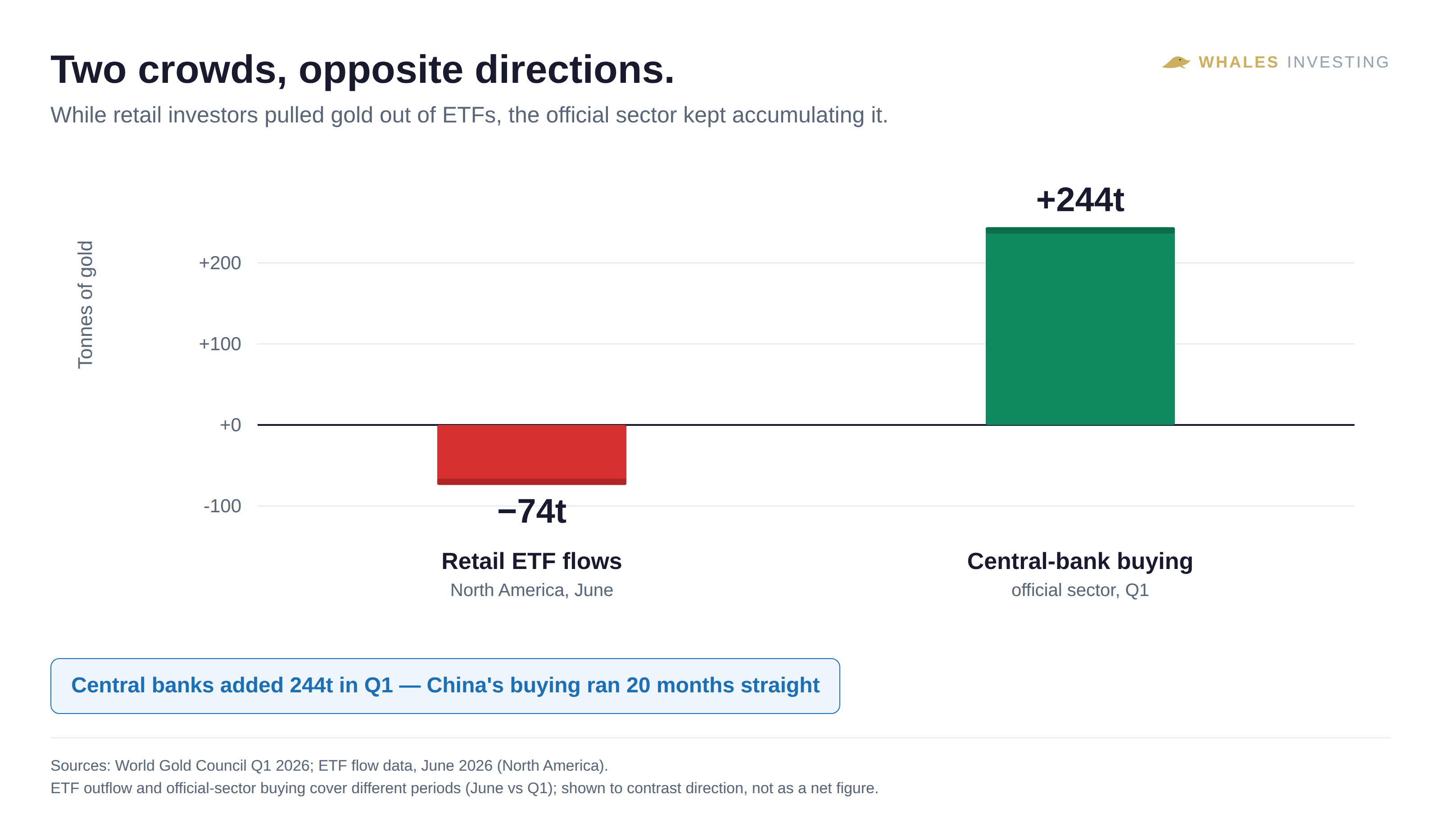
Central banks added roughly two hundred and forty-four tonnes in the first quarter alone. China’s official buying has now run twenty consecutive months; Poland has been adding all year. This is the slowest-moving, best-informed money on earth, and it is doing the precise opposite of the ETF crowd. One group sold paper into a rate scare. The other kept buying the physical metal straight through it.
That divergence — retail out, official sector in — is exactly what one gold analyst has been hammering on, and he takes it a step further than I will.
SPONSORED
Foreign central banks have dumped $82 billion in Treasuries since the conflict in Iran began. At the same time, they’re accumulating gold. For the first time in 30 years, central banks now hold more gold than U.S. Treasuries.
That’s not a small shift. It’s a monetary regime change.
My name is Garrett Goggin. I’m one of fewer than 200,000 CFAs in the world. When you study how central banks behave during monetary transitions like I have, you learn one thing: they move early. They don’t trade for short-term gains — they position for long-term stability. And what they’re telling you right now is straightforward: they trust gold more than US paper.
Go here now to check out the four top gold miners for what comes next →
Now connect central bank policy to what’s happening globally:
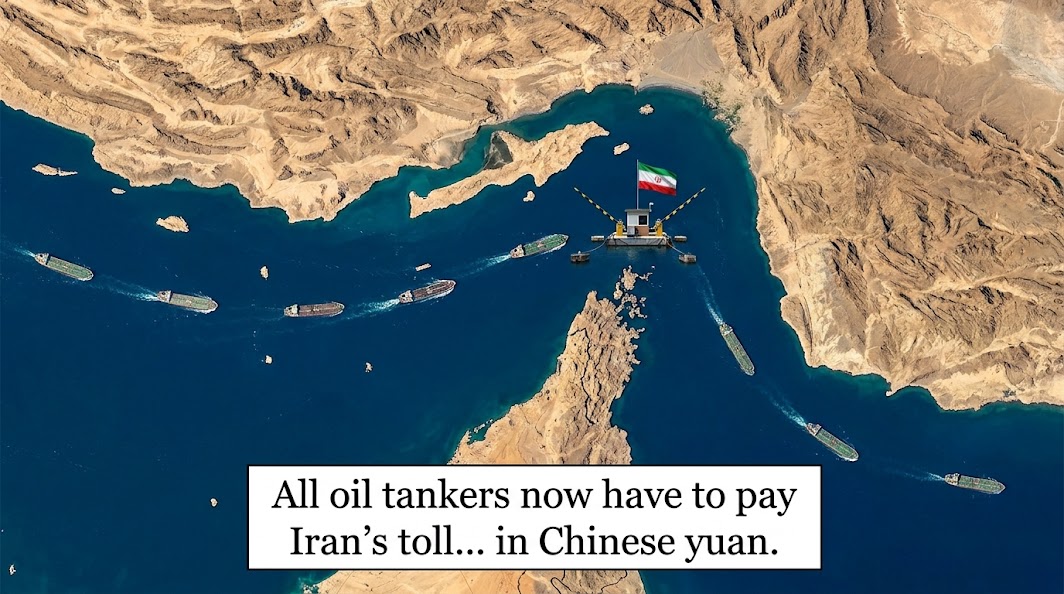
- Oil is settling in Chinese yuan thanks to the Iranian toll booth in Hormuz…
- The petrodollar deal was under extreme pressure — even before the war…
- US Treasury demand weakening…
It isn’t one event. It’s a system-wide transition underway — and transitions like this don’t reverse on a dime. They accelerate. That’s why you’re seeing stress in bond markets, higher yields, and the Fed being forced into a decision that will impact every American’s wealth. Because when dollar pressure gets bad enough, the Fed’s response is 100% predictable: they will print as much money as they need to “save the system.” Which means gold is nowhere near finished repricing. But I do not recommend buying physical gold at today’s prices. The real opportunity is in the miners still trading at deep discounts to their actual cash flow.
Whether you act on that or not, the underlying observation is sound: the official sector is buying what retail is selling. That’s the first thread. Here’s the second.
Two. The biggest companies in the world are lining up to go public
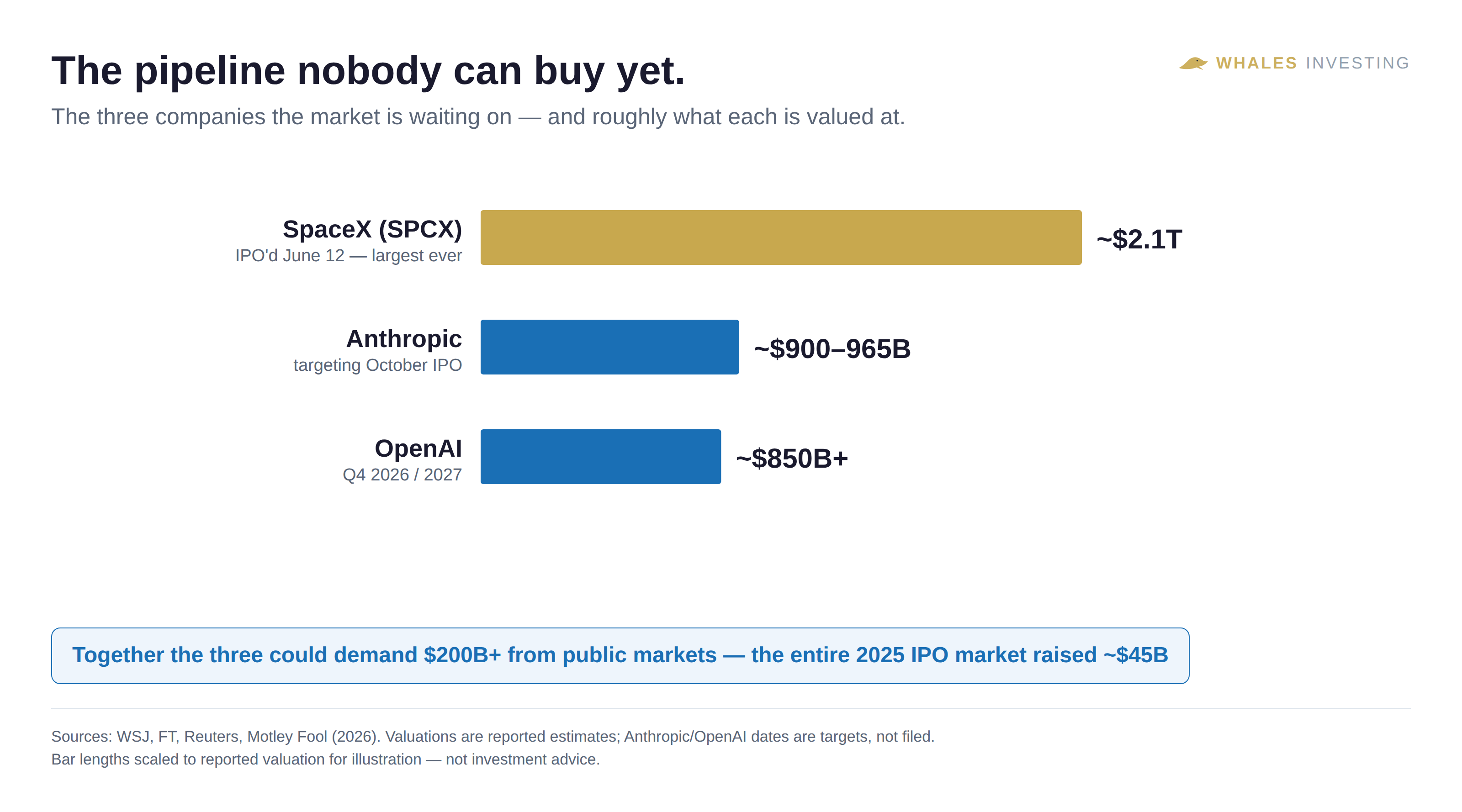
While gold grabbed the headline, the IPO pipeline quietly swelled into something the market has never seen. SpaceX went public on June 12 at roughly 2.1 trillion dollars — the largest listing in history. And it’s the warm-up act.
Anthropic, the maker of Claude, is targeting a public listing as soon as October, reportedly raising around thirty billion at a valuation near 900 billion — a raise that could beat SpaceX’s record even if the valuation doesn’t. OpenAI is circling a Q4-or-2027 debut. Put the three together and they could demand north of two hundred billion dollars from public markets. For scale: the entire U.S. IPO market raised about forty-five billion in all of 2025.
This matters even if you never buy a share of any of them. A pipeline this size pulls capital toward itself; it sets the tone for risk appetite across the whole market. And it explains the odd two-way action in tech this week — chip stocks actually fell on fear that AI hyperscalers might trim spending, even as the private AI names marched toward the exit at record valuations. The money is trying to figure out where the real leadership sits.
That question — who leads the next AI phase, and who gets left behind — is precisely what a sixty-year Wall Street veteran built his latest briefing around.
SPONSORED

A 60-year Wall Street veteran just released an urgent investment briefing. His name is Marc Chaikin. And years before Nvidia became one of the greatest AI winners in history, he saw something most completely missed.
Now, as artificial intelligence enters what he calls “light-speed mode,” Marc believes another major opportunity window is opening. But here’s the catch: not every AI stock will win. Some companies could become tomorrow’s biggest winners. Others could become yesterday’s biggest mistakes.
That’s why Marc created a FREE investment playbook showing:
- What he believes we should consider selling
- The opportunities he believes could be next
- The 5 biggest potential tech IPOs of 2026*
This is the same type of research that helped him identify major winners before the crowd. See Marc Chaikin’s latest AI investment playbook here — find out what Wall Street’s veteran stock picker is watching before everyone else.
*SpaceX, Anthropic, Waymo, YouTube, Google Cloud
Whatever you make of the pitch, the fact under it is real: the largest pool of pre-IPO value in market history is moving toward public listing this year, and it’s reshaping where capital wants to sit. That’s thread two. Thread three is the one lighting a fire under everything else.
Three. Oil spiked — and the reason should concern you more than the price
Oil rose more than ten percent on the week, with Brent pushing toward eighty-five dollars and U.S. crude near eighty. The trigger was the Strait of Hormuz — the waterway that carries roughly a fifth of the world’s oil — and the Red Sea, both back under threat as U.S.–Iran hostilities flared into a sixth straight night of strikes and a reimposed naval blockade.
I’m not going to dramatize the conflict; people are affected by it and it deserves better than to be turned into a trading hook. What matters for your money is narrow and mechanical: energy is an input to nearly everything, so an oil spike is an inflation spike with a delay. That’s the real reason those two Fed officials started talking about hikes, and the real reason the gold selling and the bond move happened in the same week. One shock, radiating outward.
There’s a longer-running strain underneath the spike, too — the slow erosion of the arrangement that kept oil priced in dollars for fifty years. That’s the thesis one publisher has built an entire briefing around.
SPONSORED

On December 12, 2025, representatives from 13 nations gathered in the backrooms of the State Department. They signed a declaration called Pax Silica.
Six weeks later, 54 more countries joined. More than 60 nations have now committed to Trump’s new monetary order. Trillions of dollars are already moving. And most Americans have no idea any of this happened.
Porter Stansberry — who predicted the emerging market collapse, the dot-com bust, and the 2008 crisis — says this is the most important financial event of his career. He has identified five companies sitting at the center of what he calls Trump’s New Dollar.
You don’t have to buy the “new dollar” framing to take the core point seriously: the dollar’s role in global energy trade is under more pressure than it’s been in decades, and an oil shock in the Gulf is exactly the kind of event that accelerates it. Which brings all three threads back to a single number.
Four. The number that ties it all together
The thirty-year Treasury yield closed the week at 5.11 percent — its highest since 2007. That’s the interest rate the U.S. government pays to borrow for a generation, and it climbed even though June inflation came in softer than expected. Normally, cooler inflation pulls long yields down. This time they rose anyway.
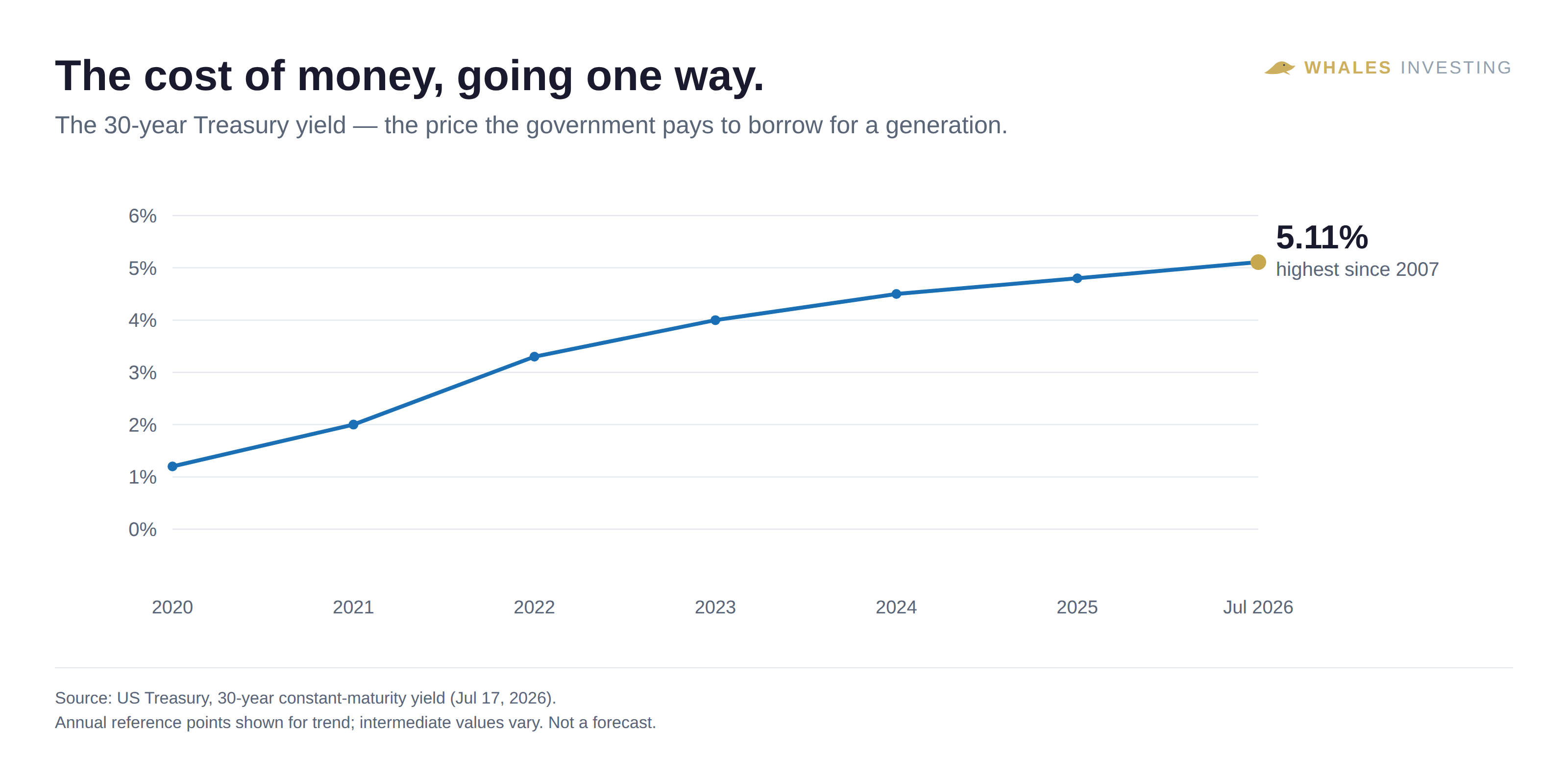
When long-term borrowing costs rise while inflation cools, the driver is usually something other than inflation: a flood of new debt issuance, weaker foreign appetite for Treasuries, or a market quietly repricing the risk of lending to the government for thirty years. Notice how neatly that lines up with the other three threads. Central banks selling Treasuries and buying gold. An energy shock straining the dollar’s global role. A capital pool so large it’s rearranging risk appetite. The thirty-year yield is where all of that shows up as a single, honest number — and it doesn’t reverse on the timeline of a weekly gold chart.
Retail watches the price. The bond market watches the plumbing. This week, they were looking at two different things.

Analyst's Note. Three different people are quoted above selling three different things, and I'd hold all of them at arm's length — a down week is exactly when the table-pounding gets loudest and the judgment gets worst. But strip away every pitch and the same structure remains: two Fed voters calling for hikes, a thirty-year yield at a seventeen-year high, an official sector buying the gold retail is dumping, an energy shock straining the dollar, and the biggest pre-IPO pipeline in history pulling at risk appetite. Those aren't five stories. They're one system under quiet strain. How you position for it — physical metal, miners, the AI names, energy, or simply more cash and more patience than the crowd — is yours to decide. My only claim is that the strain is real, and it won't announce itself in a headline.
The Bottom Line
Gold falling was the story that got told. It was the least of what happened. The official sector kept accumulating the metal retail sold; a record wall of trillion-dollar companies moved toward public markets; an oil shock in the Gulf lit a fresh inflation fuse; and the thirty-year yield — the truest gauge of what it costs to carry this much debt — closed at a level not seen since before the last crisis.
Four numbers, one direction. The cost of holding the system together is rising, and the best-informed money is repositioning quietly while the crowd argues about a one-week price move.
Protect first. Position for the regime you’re actually in, and follow the money that moves early rather than the money that reacts to headlines. Because the capital you keep is the only capital that compounds.
— Hawk