🐋 Oil Crossed 100 Dollars. Gold Didn't Move. That Should Bother You.
Brent has gained forty percent in three weeks and closed above triple digits for the first time since May.


Desmond Hawk | July 24, 2026
Brent crude settled at $100.69 a barrel on Thursday, up about seven percent in a single session and above triple digits for the first time since late May. That was the fifth straight session of gains. Zoom out and the number gets harder to dismiss: Brent started this month at $71.57. The rally is roughly forty percent in three weeks.
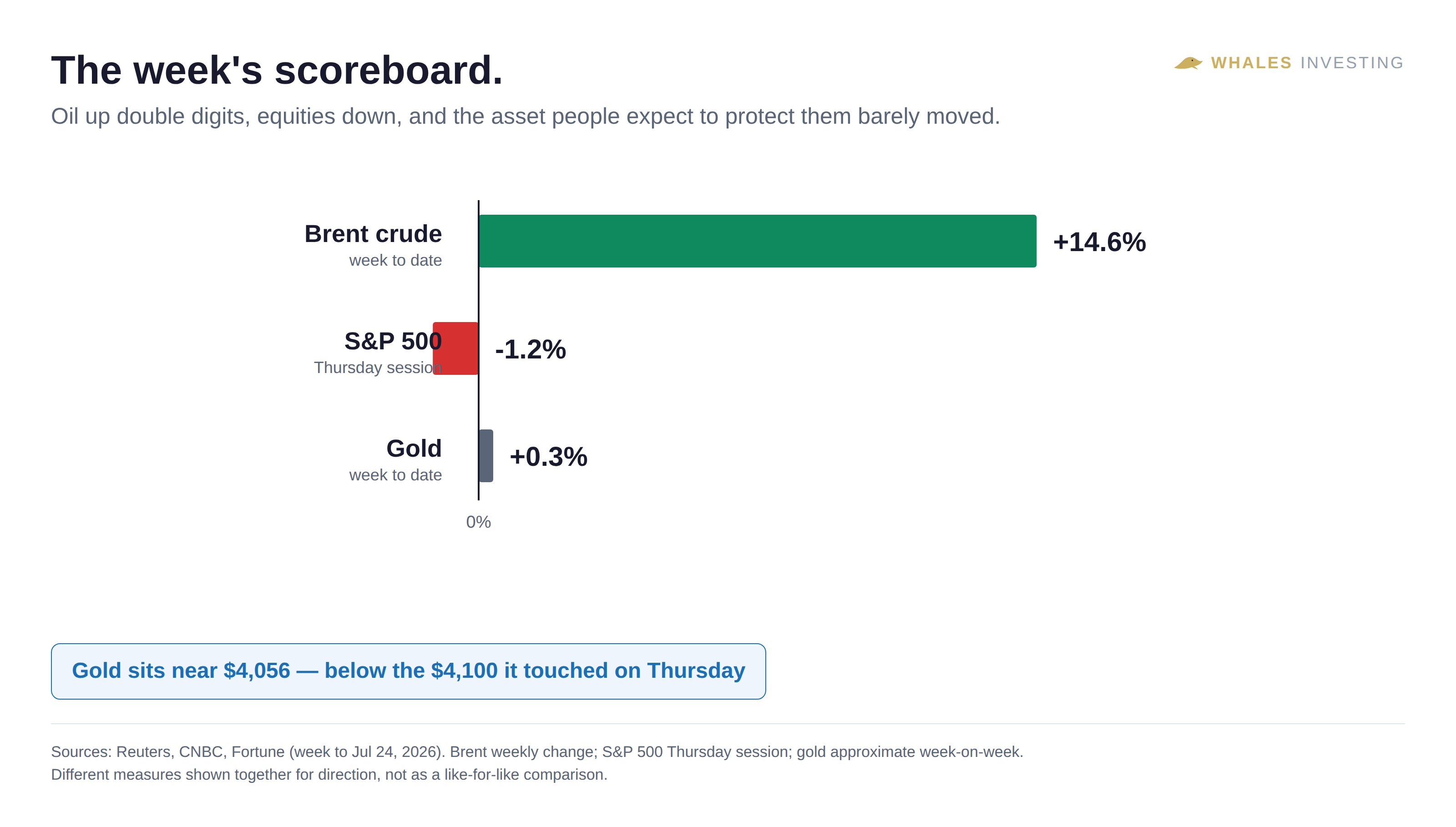
Now hold that next to a second number. Gold trades around $4,056 an ounce this morning — barely changed on the week, and below the $4,100 it briefly touched on Thursday.
War in the Gulf. Tankers hit. Crude up forty percent. And the metal people own specifically as insurance against exactly this sort of week did essentially nothing. That gap is the most instructive thing on the screen today, so let’s take it apart properly.
One. What actually happened in the Red Sea
The trigger was specific and worth understanding, because the market’s reaction depends entirely on the geography.
Houthi forces said they struck two Saudi crude tankers — the Encelia and the Layla — in the Red Sea, framing it as enforcement of a blockade of Saudi ports they declared on July 20. The claims haven’t been independently verified. What makes this different from previous flare-ups is where those ships were headed. Saudi Arabia’s Petroline pipeline runs roughly 1,200 miles overland specifically so crude can bypass the Strait of Hormuz — and it terminates at Yanbu, on the Red Sea.
So this isn’t a second threat sitting alongside Hormuz. It’s a strike on the workaround for Hormuz. Both the main route and the backup are now contested at once. Ship-tracking data showed exactly one tanker crossing the Strait of Hormuz on Thursday, the fewest since May 7. Separately, the Caspian Pipeline Consortium — which handles around two percent of global daily crude supply — stopped receiving oil from Kazakhstan after suspending loadings.
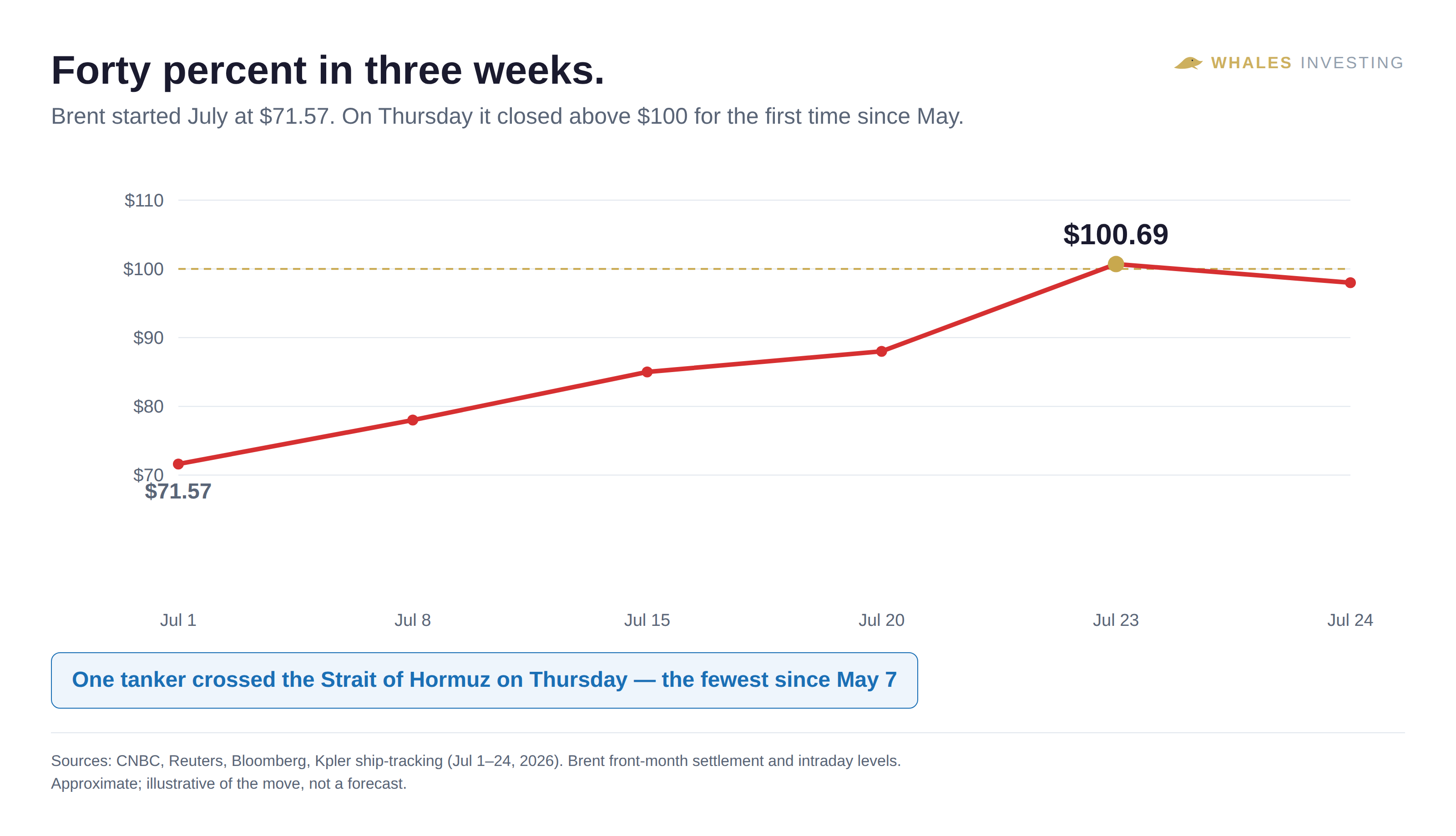
Prices eased back below $100 today, down around three percent, as traders weighed the economic damage of expensive energy and a fresh round of US tariffs. But Brent is still heading for its fourth consecutive weekly gain, up roughly fourteen percent on the week alone. The retreat is smaller than it looks.
Two. Why gold sat out its own moment
Here’s the part that confuses people, and it deserves a clear answer rather than a mystical one.
Gold has two very different buyers. The fast money trades it against interest rates, because gold pays no yield — when rates look like they’re rising, holding a non-yielding metal costs you more, so traders sell. The slow money buys it as a reserve asset and doesn’t care what the ten-year did this morning.
This week the fast money set the price. Expensive oil feeds inflation, inflation invites rate hikes, and so the rate-driven seller overwhelmed the crisis-driven buyer. Gold’s failure to rally wasn’t a verdict on gold. It was a verdict on rates.
Which raises the obvious question of who the slow money is and what it’s doing while traders fight over the ten-year. That’s the subject of one of the pitches circulating this week.
SPONSORED
Washington needs gold higher.
Its 8,133 tons at Fort Knox sit on the books at $42.22 an ounce — a 1973 price. Treasury Secretary Bessent has publicly stated his intention to revalue those reserves. It’s Washington’s only remaining counter-move in a dollar war it didn’t start.
Beijing needs gold higher too.
Every ounce accumulated weakens the dollar. A rising gold price is Beijing winning. They’ve made it illegal to export a single ounce. Their central bank ordered US Treasuries sold. The war has been running since 2009.
Two superpowers. Opposite goals. The same weapon pointed in the same direction.
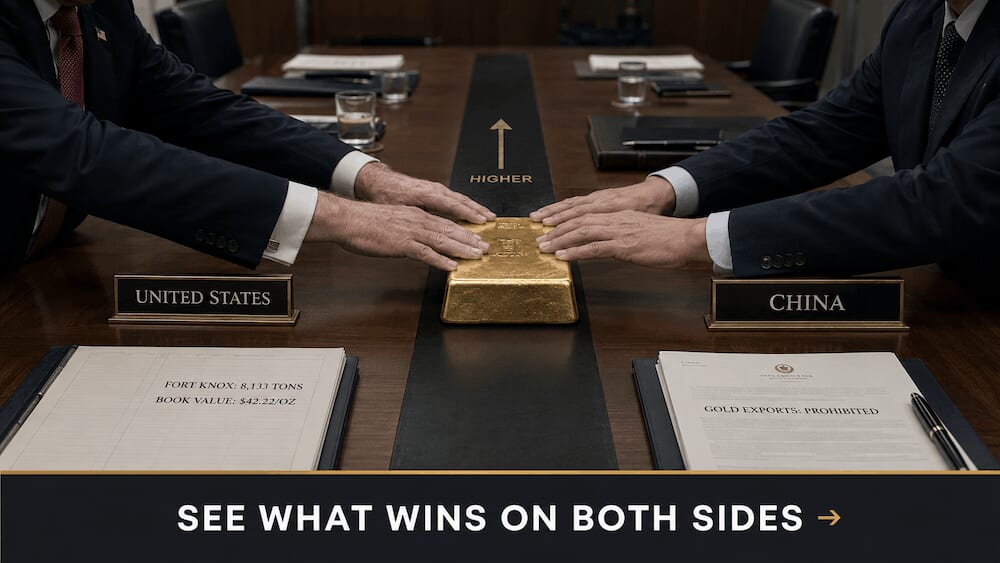
When both sides of a conflict need the same outcome — that outcome tends to happen.
There is a small group of positions that benefits regardless of which side wins.
I’d separate the documented from the speculative there. The Fort Knox book value of $42.22 an ounce is real and genuinely absurd — it dates from 1973 and has nothing to do with what the metal is worth. Whether anyone acts on it is a different question, and one I’d hold loosely.
Three. The rate conversation flipped in forty-eight hours
Two days ago, traders put roughly sixty-one percent odds on a Federal Reserve rate hike by September. This morning that number is above seventy-eight percent. The probability of a move at next week’s meeting has climbed to around thirty-four percent, though the meeting is still expected to hold. The ten-year Treasury yield pushed back above 4.7 percent.
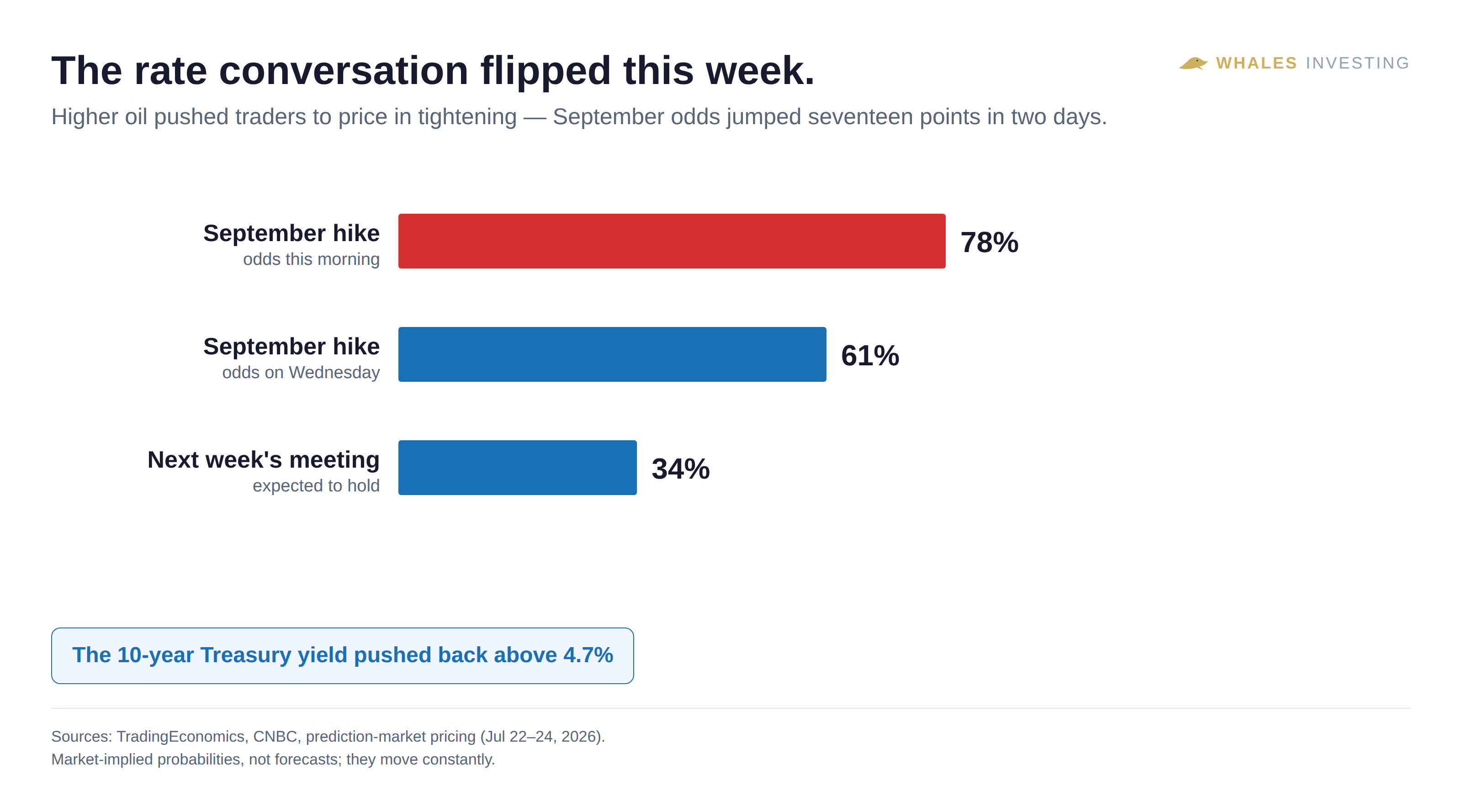
Nothing in the American economy changed to justify that. Jobless claims actually came in stronger than expected at 187,000 against a forecast of 212,000. What changed is the oil price, plus a fresh set of US tariffs of ten to twelve and a half percent on imports from major trading partners — a second inflationary input arriving in the same week as the first.
That combination is what turned Thursday ugly for equities. The S&P 500 fell 1.2 percent, its worst single day in a month. The Nasdaq dropped 2.2 percent. A gauge of megacap stocks had its worst session since April of last year. Today the market is trying to recover as crude slips back — the Dow up around 0.7 percent — but a week that swings this hard in both directions tends to attract a particular kind of pitch.
SPONSORED
Twenty-eight years.
That’s how long Dave Aquino traded options professionally — a decade at Merrill Lynch, then managing more than $650 million in options income strategies for Vanguard’s wealthiest clients.
And the thing he kept coming back to, after all of it?
One setup. One focused window. One “rinse and repeat” ticker.
Not because options are simple. Because after 28 years, he knew exactly what to ignore.
Nearly 900 trades. 95.3% success rate.

He wrote it all down in a guide you can read in an afternoon. The ticker is inside. It's free.
Options are a genuine tool and also a fast way to lose money if you don’t know what you’re doing. A published success rate tells you how often trades closed green, not how much was risked to get there — those are different questions, and the second one matters more.
Four. One date, two very different things pointing at it
Look ahead a fortnight and something curious lines up. August 6 is when SpaceX reports its first quarterly results since listing in June — and it’s also the day its lock-up expires, meaning early shareholders can sell for the first time. Those two events landing together, on a stock currently trading around and below its $135 IPO price, will say a lot about how much genuine appetite exists behind the AI listing wave.
And behind that queue sits Anthropic, targeting a Nasdaq debut as soon as October at a valuation reported near $965 billion. Interestingly, at least one promotion circulating this week has fixed on the same August 6 date for entirely different reasons.
SPONSORED

August 6 could be a BIG day for one AI company.
I believe Elon Musk will make an announcement that could mint a new generation of millionaires.
Every investment bank on Wall Street will be watching this potential watershed moment. Price targets imply close to 100% upside potential.
But this story is far bigger than Elon.
It involves what famed computer scientist Ray Kurzweil calls "technological change so rapid and profound it represents a rupture in the fabric of human history."
And Nobel laureate Demis Hassabis says it could be "nothing less than the dawning of a new age for humanity."
And while SpaceX and Tesla will likely profit handsomely from this societal shift, this firm is arguably the best positioned to fully capitalize on it.
Its revenue in this space has soared by a staggering 757% in the past year.
My system recently assigned it an A rating... the same score Comfort Systems, Supermicro, and Applovin received before they soared by as much as 1,117%, 2,007%, and 1,863%, respectively.
I want to give you its name and ticker free of charge, but I must warn you...
You have to be willing to move quickly.
On August 6, Elon Musk is set to drop a bombshell that could light a fire under this company.
If you thought this AI bull market was red-hot, wait until you see what happens when this announcement drops.
-> Click here for the full story (must see before August 6)
Regards,
Louis Navellier
Senior Investment Analyst, InvestorPlace
P.S. My firm has over $300 million riding on this August 6 announcement. It's one of my most high-conviction ideas.
A predicted announcement is a prediction, not a calendar entry, and I’d keep those two categories firmly apart. What is on the calendar is the SpaceX report and the lock-up expiry. That’s the one I’d actually mark.
The metal didn’t fail this week. It was simply outvoted — by a rate market that got louder than the war did.
Analyst's Note. Three promotions ran above: one on gold reserves, one on options income, one predicting an announcement a fortnight out. Each is selling something, and a week with this much movement is exactly when that kind of certainty sells best. Strip it away and the week's facts are unusually clean. Brent gained forty percent in three weeks and crossed $100. A strike on Yanbu put Saudi Arabia's only Hormuz workaround under fire while one tanker crossed Hormuz itself. September hike odds went from sixty-one to seventy-eight percent in two days. Equities had their worst day in a month. And gold, holding still through all of it, told you that right now the rate market is setting its price — not the war. That last point is free, and it is the one I would actually carry into next week.
The Bottom Line
This was the week energy stopped being a headline and became an input. Forty percent on Brent in three weeks flows into freight, plastics, fertiliser and eventually the shelf price, and the rate market has already started pricing that arrival — seventy-eight percent odds on a September hike, a ten-year back above 4.7, and a fresh tariff round layered on top.
The lesson sitting inside gold’s flat week is worth keeping. Assets don’t protect you on a schedule. Gold is a hedge against currency debasement and long-run disorder, not an instrument that pays out the moment a headline frightens you — and confusing the two is how people end up disappointed by something that’s doing exactly what it was always going to do.
Protect first. Position for the regime you’re actually in, and know what each thing you own is actually insuring against before the week arrives that tests it. Because the capital you keep is the only capital that compounds.
— Hawk