
🐋 Nasdaq Is 1.4% From a Record. The Consumer Just Stopped Spending.
One of Those Two Facts Gets Corrected in the Next Ten Days.


Desmond Hawk | August 18, 2026
Friday told us Americans stopped spending: retail sales down 0.6 percent to $763.6 billion, consumer sentiment at 51.0, real average hourly earnings 0.2 percent lower than a year ago. This morning we start finding out whether that was one distorted month or the beginning of something. Home Depot reports before the open, and it arrives with the least generous setup a large retailer can have.
Worth noting what the market did with that news: almost nothing. Stocks held near records through Monday, which tells you the consensus still reads Friday as an aberration. This week is where that assumption gets checked four separate times.
One. The read that actually matters this morning
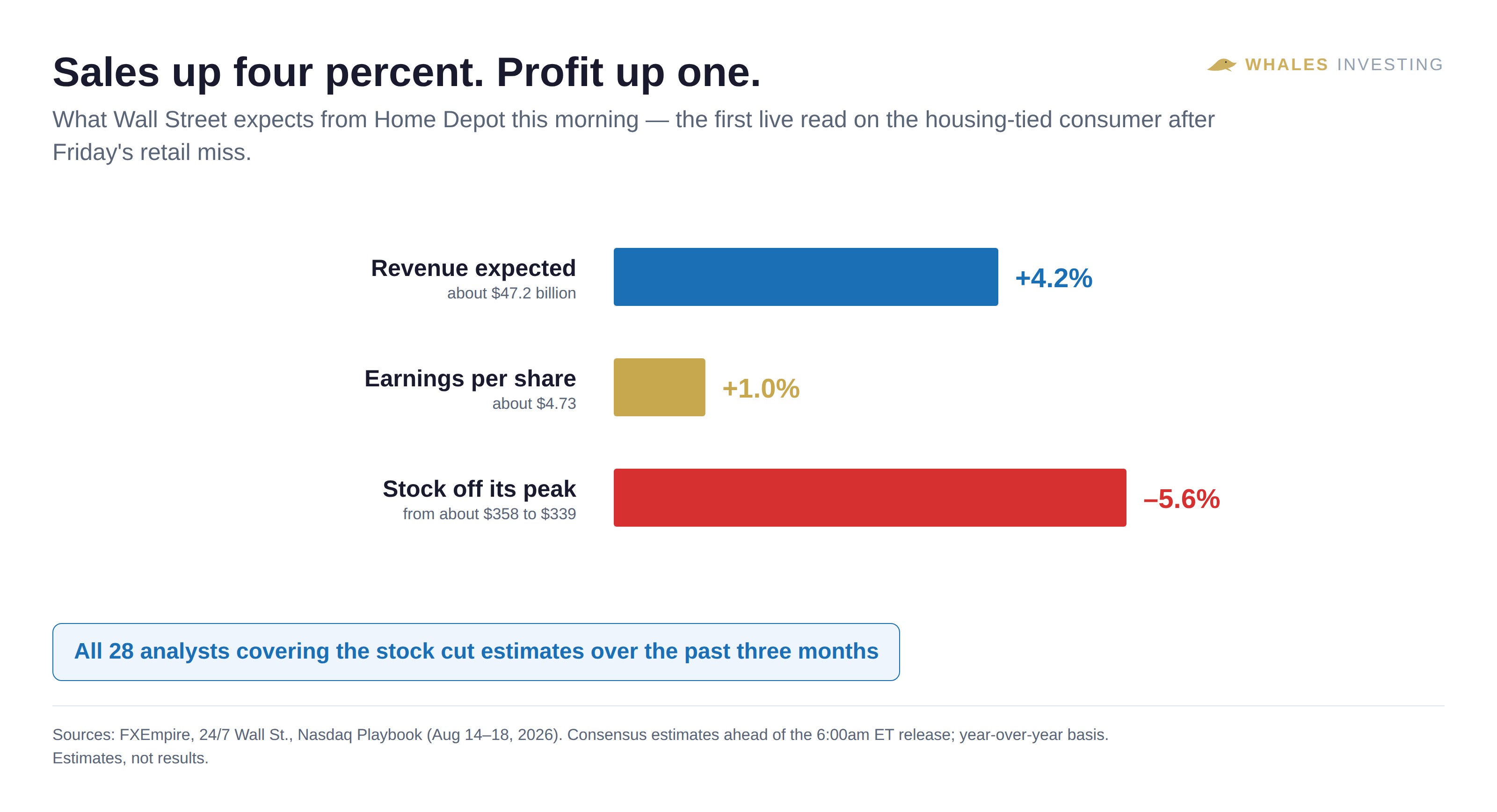
The numbers Wall Street expects: revenue near $47.2 billion, up 4.2 percent from a year ago, with earnings per share around $4.73 — up just one percent. Sales rising four times faster than profit is the arithmetic of a company absorbing costs it can’t fully pass on. The stock has already eased from a recent peak near $358 to about $339, and every one of the 28 analysts covering it has cut estimates over the past three months. Last quarter the company missed revenue by more than a billion dollars.
Why this company and not another: with housing affordability still suppressing new construction, remodelling is the last lever in the category, which makes comparable sales here a cleaner proxy for household confidence than almost any other single report. Housing starts land the same morning, expected at 1.390 million against 1.427 million previously — softer again. Target and Lowe’s follow tomorrow, Walmart Thursday.
And behind all of it sits the question of who runs monetary policy from here. The Fed publishes minutes tomorrow from the July meeting where rates held at 3.50 to 3.75 percent on a 9–3 vote, and Kevin Warsh delivers his first Jackson Hole keynote as chair on the 27th after scrapping the forward guidance markets had leaned on for years. A genuine change of regime at the central bank moves more capital than any single earnings report — which is the premise the first item on my desk this week is built on.
SPONSORED
Most financial advisors love to tell you to diversify. They want you spread across 50 different stocks, hoping for the best.

According to Market Wizard Larry Benedict, "Diversification is for dummies." > When you're watching everything, you're watching nothing. Especially now, as President Trump triggers a historic regime change at the Federal Reserve.
Trillions of dollars are about to shift. And instead of scrambling to guess which sectors will win, Larry focuses on just ONE specific ticker that sits directly at the heart of Fed policy.
This exact ticker previously helped his readers capture massive double and triple-digit gains during market shocks.
Today, he's giving the name of this ticker away completely free. No guesswork. No complicated charts. Just one symbol you can trade right from your phone in under 60 seconds.
Back to yesterday’s data — because one survey came in strong and still managed to say something uncomfortable.
Two. The survey beat, and the internals didn’t
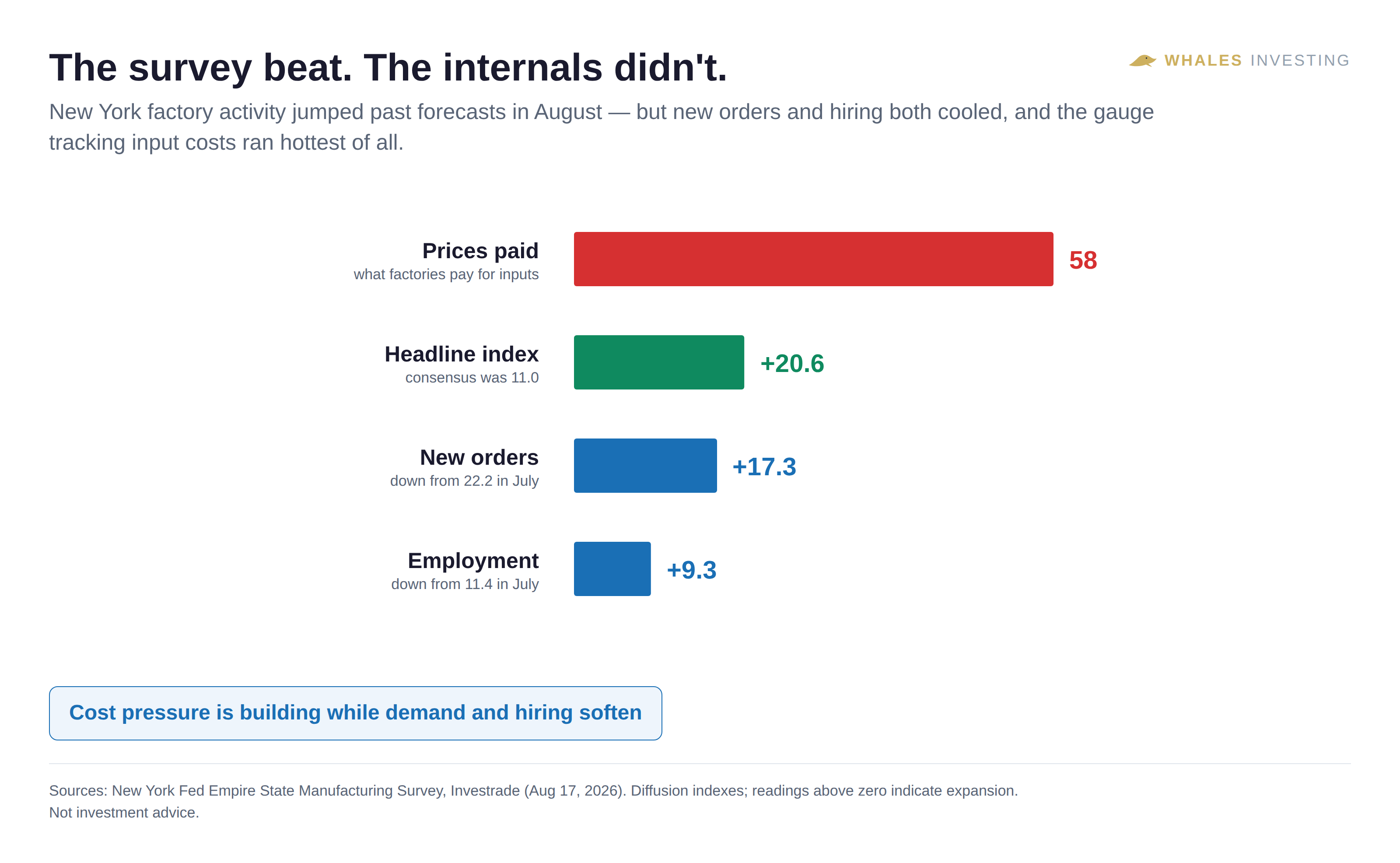
New York factory activity jumped to 20.6 in August against a consensus of 11.0, up from 15.6 in July. On the headline that is a clear beat. Look one level down and the picture divides. New orders slipped to 17.3 from 22.2. The employment gauge fell to 9.3 from 11.4. Meanwhile the index tracking what factories pay for their inputs advanced to 58 — far above every other component in the survey.
That combination — softening demand, cooling hiring, rising input costs — is the least comfortable arrangement for a central bank, because the two halves argue for opposite decisions. Cut rates to support demand and you feed the cost side; raise them to contain costs and you deepen the slowdown. It also matches what last week’s producer report showed once you stripped out food, energy and trade services: a 0.4 percent monthly jump, four times June’s pace, driven largely by a 6.5 percent rise in portfolio management fees that feeds the Fed’s own preferred gauge on August 26.
Energy is doing its part. Oil is up roughly five percent from a week ago, with West Texas near $82 and Brent near $88. The Strait of Hormuz has been choked for more than half of 2026, and America’s Strategic Petroleum Reserve now sits below 300 million barrels — a level last seen in the 1980s. Import prices, out this morning, are the next place that shows up. Costs arriving through the pipeline while wages fall behind is precisely how a currency quietly buys less each year without any single dramatic event, and that longer erosion is the subject of the next presentation on my desk.
SPONSORED
It didn't require a vote from Congress, and it didn't need a public debate.
With a single stroke of a pen, President Trump is moving forward with replacing the traditional dollar infrastructure.

This triggers the biggest structural transformation to America's money in 52 years, completely resetting the rules for cash, savings, and retirement accounts.
A massive shift in wealth has already started behind closed doors.
Porter Stansberry has just gone live with an urgent briefing detailing the five vital companies positioned to capture this new monetary order — including the exact name and ticker symbol of his #1 stock to buy before the markets move again.
Don't Click Away.
Which brings us to what the rest of this stretch actually decides.
Three. Four tests in ten days
The calendar from here is dense. This morning: Home Depot, housing starts, industrial production, import and export prices. Tomorrow at two o’clock: the Fed minutes. Wednesday and Thursday: Target, Lowe’s, Walmart. Then core PCE on August 26, carrying last month’s hidden pipeline acceleration, and Jackson Hole from the 27th.
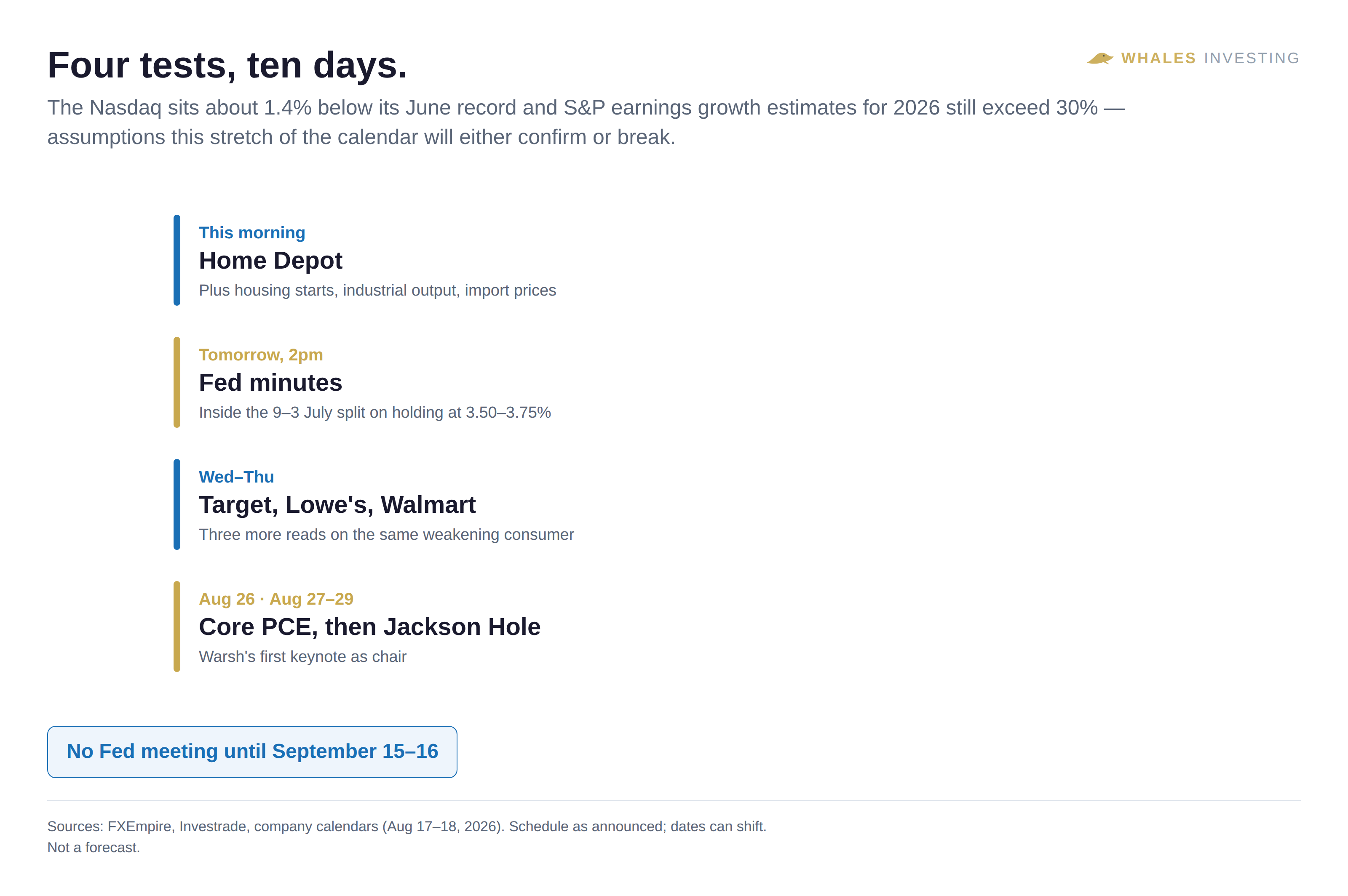
Set against that, the market’s own position is worth stating plainly. The Nasdaq closed Monday around 26,729, roughly 1.4 percent below its June record. Full-year 2026 earnings growth estimates for the S&P 500 still exceed 30 percent, with revisions running upward across technology and commodity-linked sectors. That is an index priced for acceleration sitting on top of a consumer who just spent less for the first time in nine months.
One structural note before I close, because it sits outside all of this noise. Roughly a third of humanity still has no reliable internet connection — not a pricing problem but a coverage one, and terrestrial networks were never going to reach the last stretch economically. Satellite direct-to-cell changes that map: Apple has added Starlink support on iPhones, and the dead zones that defined the edge of the digital economy are being closed from orbit rather than the ground. Unlike an oil chokepoint, that infrastructure has no strait to block. The final item on my desk this week works from that shift.
SPONSORED

Apple’s Starlink Update Sparks Huge Earning Opportunity

Apple just secretly added Starlink satellite support to iPhones through iOS 18.3.
One of the biggest potential winners? Mode Mobile.
Mode's EarnPhone already reaches 490M+ users that have earned over $1B, and that's before global satellite coverage. With SpaceX eliminating "dead zones" worldwide, Mode's earning technology can now reach billions more in unbanked and rural populations worldwide.
Their global expansion is perfectly timed, and you still have a chance to invest in their potentially pre-IPO offering before it closes.
59,000+ investors participated in Mode's previously sold out offering and limited space remains in the current round.
With their recent 32,481% revenue growth and newly reserved Nasdaq ticker, Mode is one step closer to a potential IPO.

Please read the offering circular and related risks at invest.modemobile.com. This is a paid advertisement for Mode Mobile’s Regulation A+ Offering.
Mode Mobile recently received their ticker reservation with Nasdaq ($MODE), indicating an intent to IPO in the next 24 months. An intent to IPO is no guarantee that an actual IPO will occur.
The Deloitte rankings are based on submitted applications and public company database research, with winners selected based on their fiscal-year revenue growth percentage over a three-year period.
Twenty-eight analysts cut their estimates and the stock still trades near the top of its range. Costs at 58 while orders and hiring cool. An index 1.4 percent from a record above a consumer who just pulled back. Something in that arrangement gets repriced in the next ten days.

The Setup. Home Depot reports at 6:00am ET: consensus revenue about $47.2 billion (+4.2% year over year) and EPS near $4.73 (+1%); all 28 covering analysts cut estimates in the past three months, and the stock sits near $339 against a recent peak of about $358. Housing starts are expected at 1.390 million versus 1.427 million prior, building permits 1.380 million versus 1.367 million, import prices +0.1% and export prices +0.2%. The Empire State index came in at 20.6 against an 11.0 consensus, but new orders fell to 17.3 from 22.2, employment to 9.3 from 11.4, and prices paid rose to 58. WTI sits near $82 and Brent near $88, up roughly 5% on the week; the Strategic Petroleum Reserve is below 300 million barrels. The Nasdaq closed near 26,729, about 1.4% under its June record. Fed minutes land tomorrow at 2pm, core PCE on August 26, Jackson Hole August 27–29, and there is no Fed meeting until September 15–16.
The Bottom Line
This morning is the first honest test of Friday’s warning. If Home Depot’s comparable sales hold up, the retail miss looks like a July distortion — Prime Day moved into June, tax refunds faded, one bad month. If they don’t, then a 0.6 percent drop in spending, sentiment at 51 and negative real wages start looking like a pattern rather than noise, and three more retailers report into that reading before the week is out.
The harder problem is the one the Empire State survey exposed. Demand and hiring are cooling at the same time input costs are climbing, and no interest-rate decision fixes both. That is the argument the Fed had in July, it is what the minutes will show tomorrow, and it is why a single tidy inflation print last week settled far less than the rally suggested.
Protect first. Position for the regime you’re actually in, and judge this morning by the comparable-sales line rather than the headline beat — because the number that tells you about the consumer is rarely the one in the press release. Because the capital you keep is the only capital that compounds.
— Hawk