
🐋 Musk Asked to Launch a Million Satellites
Almost nobody read the filing. The AI story stopped being about chips — it's about electricity, and one company just asked for a way around the grid entirely.

Desmond Hawk | July 16, 2026
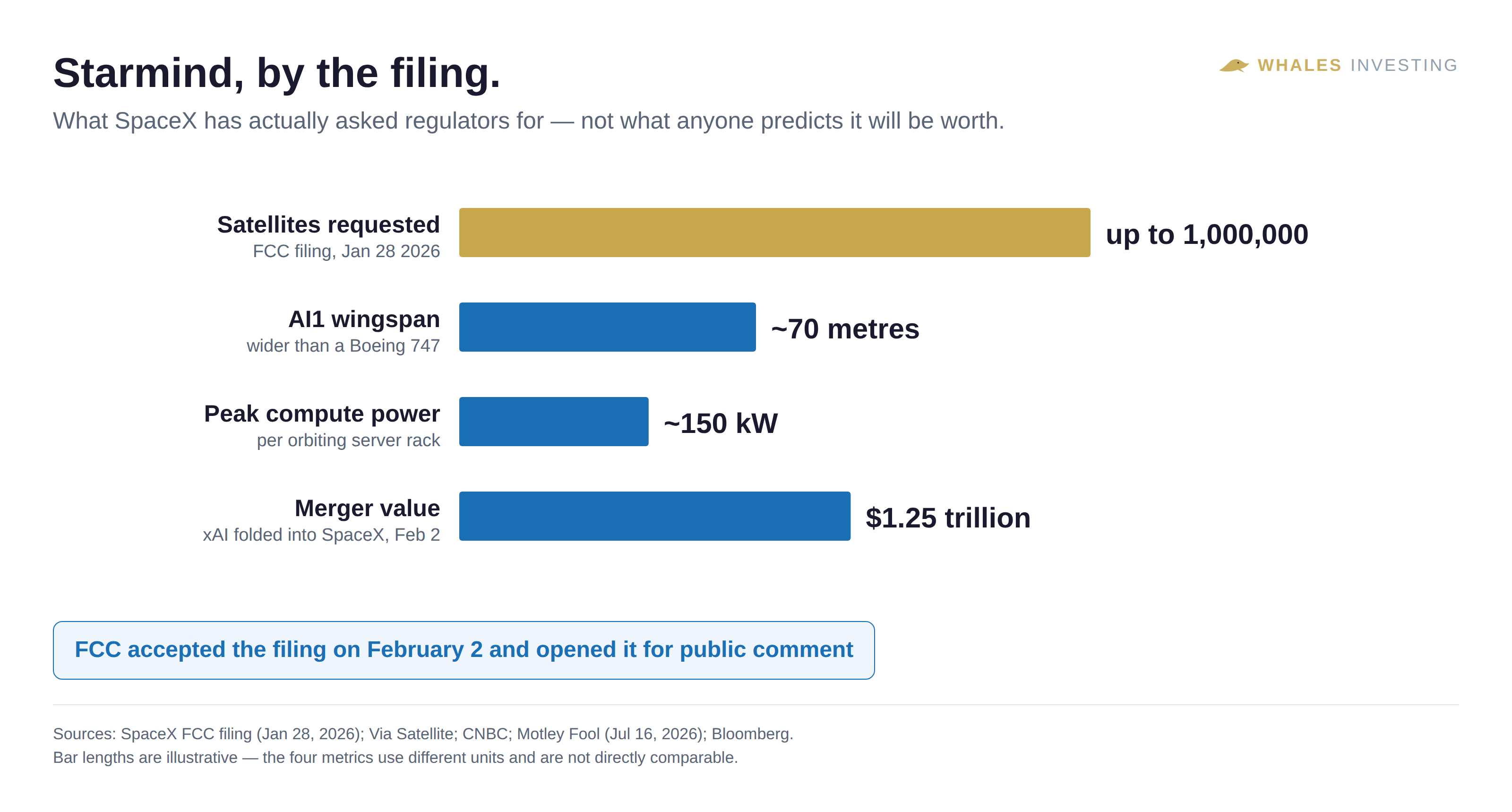
On the 28th of January, SpaceX filed a request with the Federal Communications Commission. It asked for authority to launch up to one million satellites.
Not one thousand. One million.
The filing was accepted on the 2nd of February and opened for public comment. The FCC chairman posted it on X himself. And almost nobody outside the satellite trade press read a word of it, because that same week Musk folded his AI company into SpaceX in a 1.25 trillion dollar all-stock deal, and everyone was busy arguing about the valuation.
The filing is the more interesting document. Here’s why.
The Bottleneck Stopped Being Chips
For two years, the AI story was a shortage story about semiconductors. Whether you could get H100s. Whether TSMC could package them fast enough.
That’s over. GPU availability has improved measurably. What hasn’t improved is the thing you plug them into.
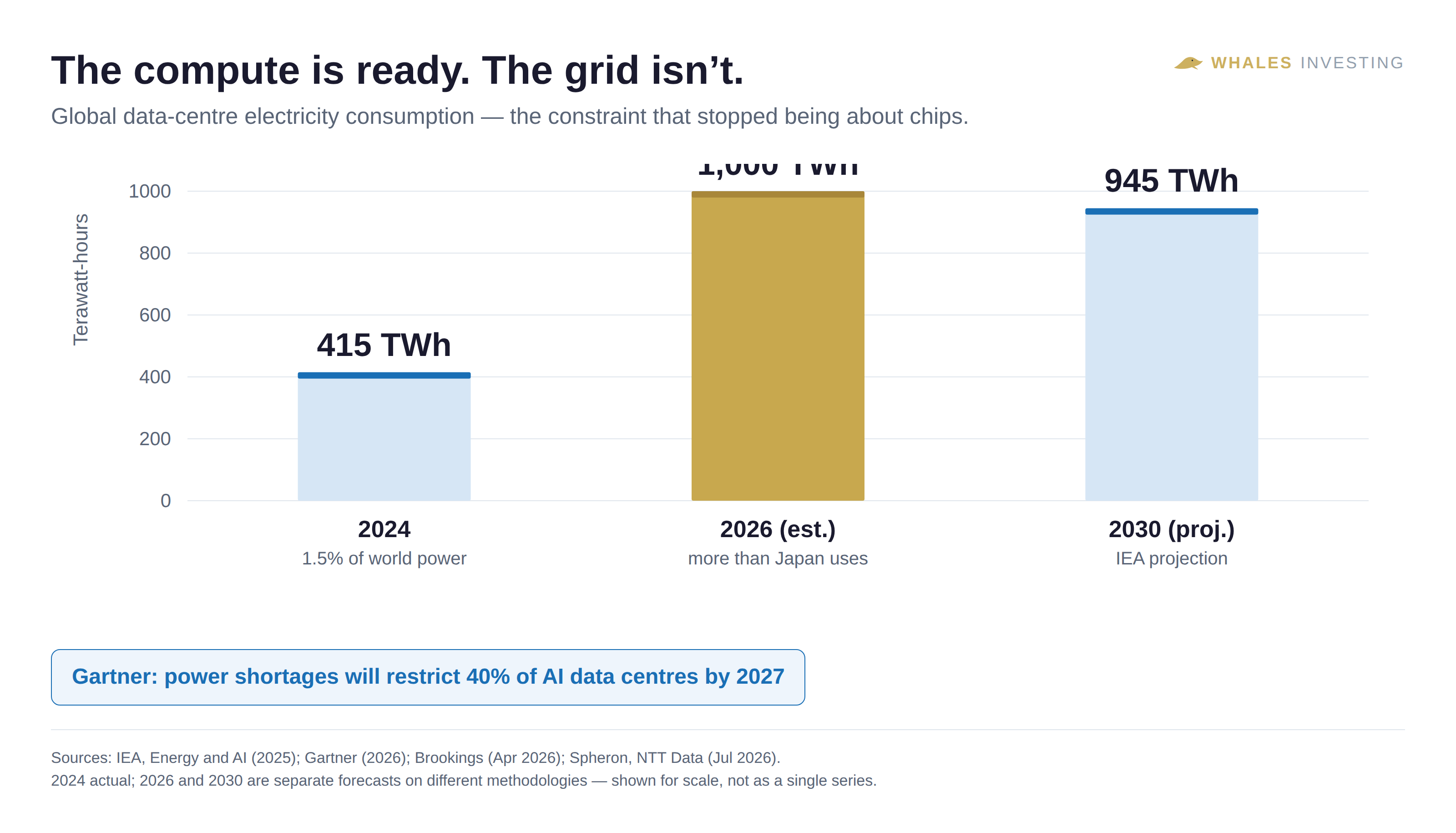
Global data centre electricity consumption hit 415 terawatt-hours in 2024 — about one and a half percent of all electricity used on Earth, growing at twelve percent a year, four times faster than overall electricity demand. Gartner now estimates the figure passes a thousand terawatt-hours this year. That is more electricity than Japan consumes.
A single AI query can draw up to a thousand times the electricity of a conventional web search. Modern AI facilities need between a hundred and seven hundred and fifty megawatts each. Utilities cannot build transmission fast enough, and the interconnection queue — the bureaucratic process of getting a new building attached to the grid — has become the binding constraint on the entire industry.
Gartner’s projection: power shortages will restrict forty percent of AI data centres by 2027. Not slow them. Restrict them.
That is the problem Musk was looking at when he decided the answer was orbit.
What the filing actually describes
The project has a name — Starmind — and the specifics are unusually concrete for something that sounds like science fiction.
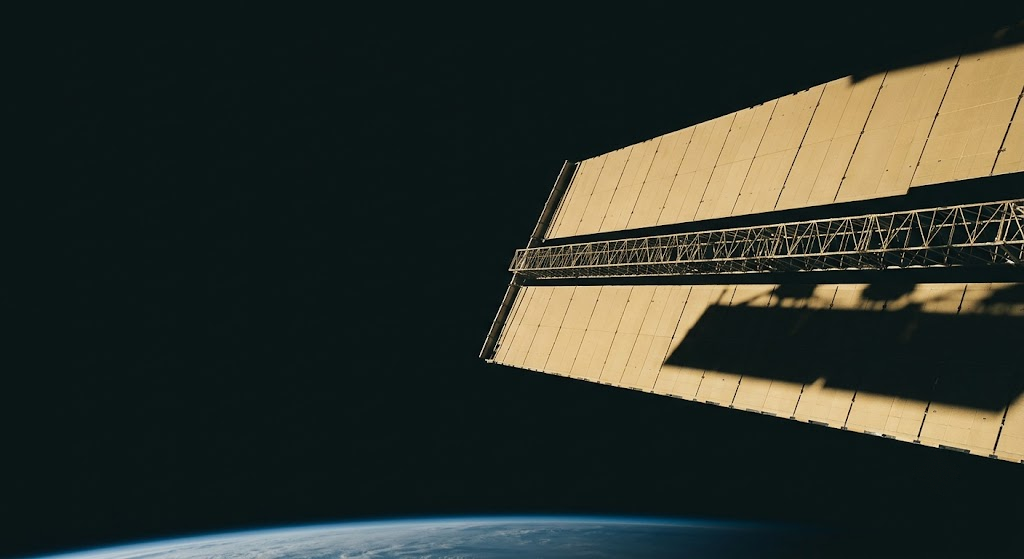
The satellite is called AI1. It functions as an orbiting server rack, delivering roughly a hundred and fifty kilowatts of peak compute. It spans about seventy metres tip to tip, which makes it wider than a Boeing 747. The chips aboard run Grok. Power comes from solar, unfiltered by atmosphere. Cooling is the vacuum.
Musk’s stated logic, from the merger announcement in February: terrestrial infrastructure cannot meet the electricity demands of AI, and moving compute to space is “the only logical solution.” He put a timeline on it — within two to three years, he said, the cheapest way to generate AI compute would be in orbit.
In June, SpaceX went public. Shares closed at 161 dollars, valuing the combined company at 2.1 trillion. Musk briefly became the first person in history worth a trillion dollars. On the 6th of July, xAI formally disappeared as a brand — the merged entity is now SpaceXAI.
SPONSORED

Forget SpaceX, Elon’s M.A.G.I. Could Be Bigger
While everyone was distracted with the recent SpaceX IPO...
Elon Musk quietly filed a patent with the U.S. Patent and Trademark Office to protect what Jeff Brown believes will be his next breakthrough...
Something he called “the greatest tech invention in history.”
Elon is predicting this new AI breakthrough will unleash a $1 quadrillion new wealth wave.
The part the excitement leaves out
Now the counterweight, because there always is one and it rarely makes the headline.
Dissipating heat in a vacuum is genuinely hard — there is no air to carry it away, only radiation. Cosmic radiation degrades electronics over time. And when a server fails three hundred miles up, nobody drives out to replace it. The costs are enormous. Timelines this ambitious slip as a rule, not as an exception.
There is also a less romantic reading of the merger itself, and it is worth sitting with. xAI was burning billions and needed capital badly. SpaceX had the deepest pockets and an IPO coming. CNBC’s assessment at the time was blunt: the orbital data centre vision is for a far-off future, but the cash requirement was immediate. The merger solved a funding problem today and a compute problem someday.
Both readings can be true. Musk has a long record of pulling forward things that sounded absurd when he described them, and an equally long record of describing them years before they worked.
Musk isn’t pitching something fully baked. He’s pulling the future close enough for the market to price it in.
That line is from Chris Burke, quoted during the IPO discussion, and it is the most honest sentence written about this company all year.
What this is actually about
Strip away the theatre and there’s a simple observation underneath.
Every serious AI operator on Earth is now an energy company that happens to run software. That’s not rhetoric — it’s what the capital allocation says. Firms are building their own generation because they cannot wait for the grid. Analysts are modelling small modular reactors next to server halls. The constraint moved from silicon to electrons, and it moved fast enough that most portfolios haven’t caught up to the fact.
Musk’s answer is the most extreme version of that logic: if the grid is the ceiling, leave the planet. Whether Starmind works is genuinely unknowable today. But the reasoning that produced it — that compute is now bounded by power, and whoever solves power owns the next decade — is not speculative at all. It’s the most consensus view in infrastructure right now, and the numbers back it.
Analyst’s Note. I have no idea whether there will be a server rack in orbit in three years, and neither does anyone else — including the people selling you the story either way. What I do know is that the question has changed. For two years the smart question was who makes the chips. It is now who can power them, and that question has an entirely different set of answers: utilities, generation, grid infrastructure, land near substations, nuclear. Musk’s satellites may or may not be part of it. But if your exposure to the AI decade is built entirely on the companies that design the silicon, you’re positioned for the bottleneck that already cleared, not the one that’s binding now. That’s the gap worth closing — and you don’t need a rocket to close it.
The Bottom Line
A company asked permission to put a million computers in space and the market barely blinked, because it was busy pricing the merger that made it possible. The filing is public. The physics is hard. The timeline is anyone’s guess.
But the reason behind it is neither speculative nor distant: the grid ran out of room before the chips did, and every serious player is now solving for electricity rather than compute. That is a structural change in what the AI trade actually is — and structural changes don’t announce themselves in headlines. They show up in filings nobody reads.
Protect first. Position for the regime you’re actually in, and pay closer attention to the constraint that’s binding now than the one everyone was arguing about last year. Because the capital you keep is the only capital that compounds.
— Hawk