🐋 At Two O'Clock This Afternoon, the Guessing Ends
The Fed's most uncertain decision in years lands today, split almost down the middle. Microsoft and Meta report after the close


Desmond Hawk | July 29, 2026
For a week I’ve been describing a market bracing for a decision it couldn’t call. Today it finally gets the answer. At 2 p.m. Eastern the Federal Reserve announces its rate decision, and for once the outcome is genuinely unknown — not because the data is confusing, but because the man in charge has made unpredictability his method.
Two hours after that, Microsoft and Meta report earnings, the two largest AI spenders on the board. And beneath both events, something quieter and arguably more important is already underway: the money that has driven this market for two years is starting to change seats. Three moving parts, one afternoon. Let me take them in order.
One. The most uncertain Fed decision in years
Start with the number that captures it. Hours before the announcement, traders put roughly a 64 percent chance on the Fed holding rates steady for a fifth straight meeting — and a 36 percent chance on the first rate hike in three years. A one-in-three probability of a hike on decision day is extraordinarily high; normally the market has this pinned well in advance.
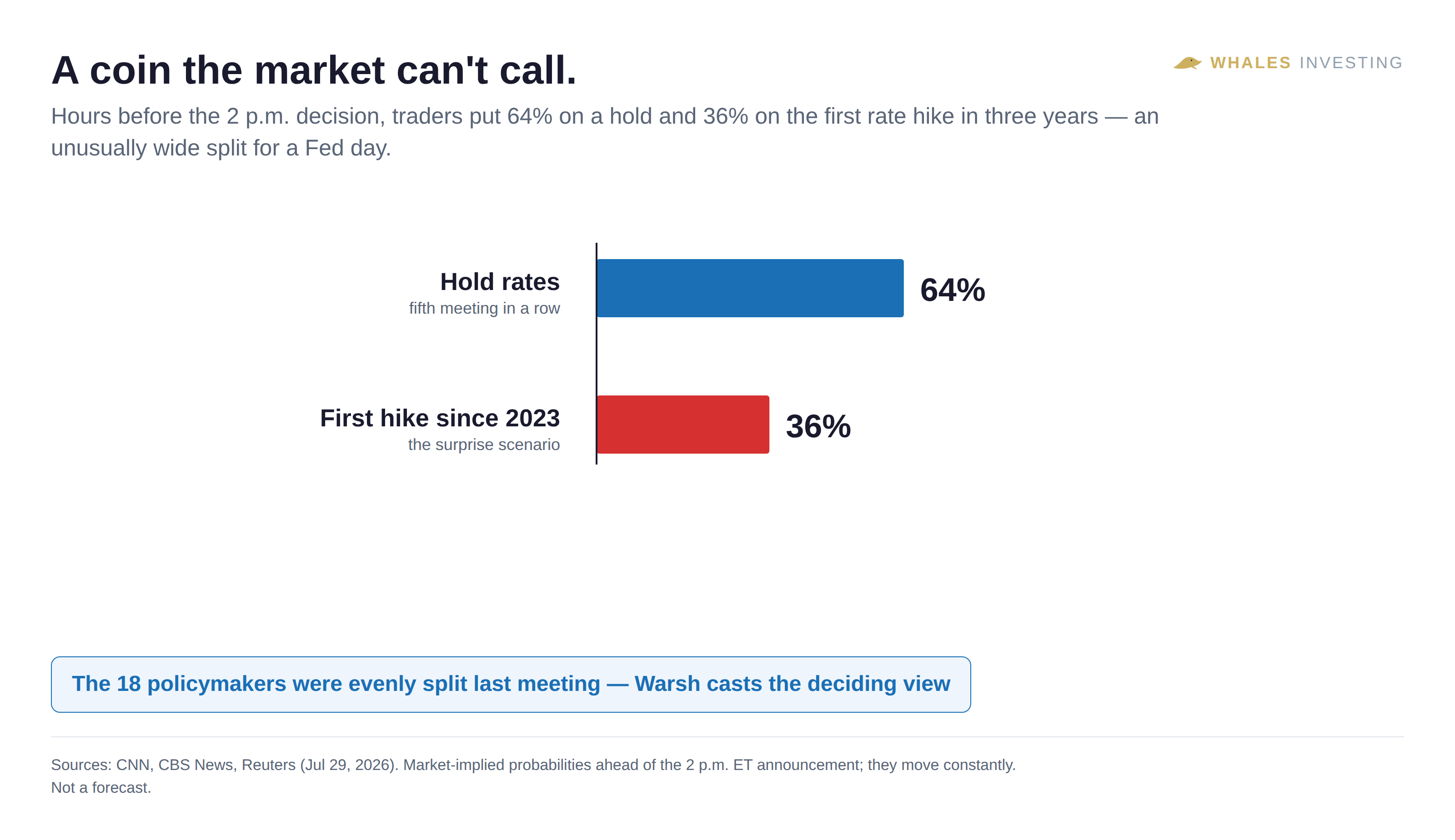
The reason is the chair. Kevin Warsh has scrapped the forward guidance the Fed leaned on for a decade — at the June meeting he declined even to submit economic projections, though nearly half of policymakers said they’d support a hike later this year. Those eighteen officials were evenly split last time, which leaves Warsh to cast the deciding view. One trading desk, Citadel Securities, has told clients it expects a surprise hike specifically to establish Warsh’s credibility as an inflation-fighter. The President, who appointed him hoping for cuts, said this week rates should be “the lowest in the world.”
So this is not really about a quarter-point. It’s about whether a new chair uses his first genuinely contested meeting to prove he means what he says — and about what he does or doesn’t tell us at 2:30. That question of the dollar’s stewardship is exactly the anxiety the first pitch on my desk this week is built to sell.
SPONSORED
What’s really happening in the Middle East isn’t just about oil or politics — it’s about control.
With oil prices rising, inflation pressure mounting, and global trust in the dollar eroding, the Fed has no choice but to act. And when they do, gold could become the only real safe haven.
The Gold Cartel is already moving. The question is: Will you be positioned when the dollar cracks?
Get the full analysis before the next move happens >>
Click here to access the crisis briefing now
A “carefully orchestrated plan” and a “Gold Cartel” are the language of a thriller, not an analysis, and I’d read them that way. Strip the drama and one observation survives on its own: higher oil does pressure inflation, which does constrain the Fed, and gold has historically done well when real rates fall and confidence in currency wobbles. That’s a reason to understand gold’s role — not a reason to act on a countdown.
Two. Two hours later, the AI bill comes due
After the close, Microsoft and Meta report — and the market has already told us what it cares about. Not revenue, not even profit. Capital spending. Last week Alphabet delivered a flawless quarter and fell anyway because it lifted its capex guidance toward $205 billion. Both companies today are being judged on whether their own AI spending is producing returns or just draining cash.
The setup is loaded. Microsoft is down roughly 27 percent from its high on exactly this fear, Meta around 10 percent — yet Microsoft’s most recent quarter showed a genuine AI business running near a $37 billion annual rate, up more than 120 percent, so the monetisation is real, not slideware. And overnight the memory-chip maker SK Hynix posted operating profit up an astonishing 557 percent, and its shares still couldn’t satisfy investors. That reaction tells you the mood: even spectacular AI numbers are being met with “yes, but at what cost?”
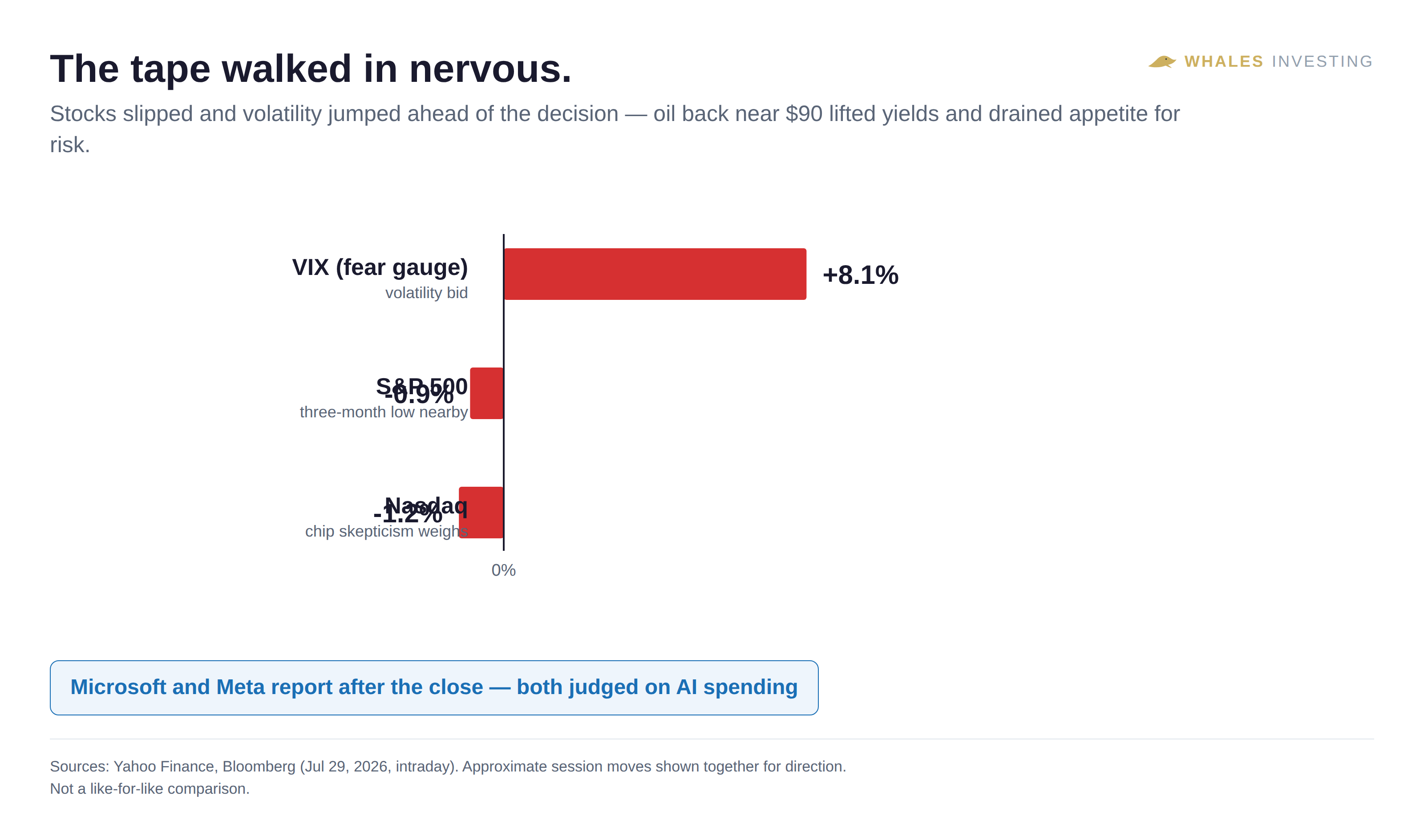
That's why the tape walked in nervous today — the S&P and Nasdaq lower, the volatility gauge up more than eight percent, oil back near $90 lifting yields and draining risk appetite. The market is bracing to find out, in a single evening, whether the most expensive bet of the decade is paying off. The historical framing behind that dollar anxiety is the pitch of the second promotion this week.
SPONSORED
Take a look at this formerly classified document:
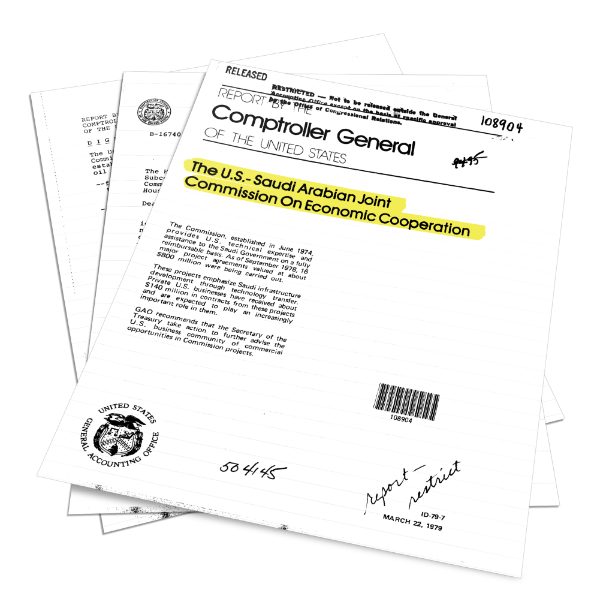
Most people (professionals included) have never heard of it…
But it’s been quietly protecting the value of your savings, your retirement, and every dollar in your wallet for the last 50 years.
Created under Henry Kissinger in 1974…
It had a name only Washington could love: The U.S.–Saudi Arabia Joint Commission on Economic Cooperation.
For half a century, it helped tie global oil trade to the U.S. dollar…
Keeping demand for dollars artificially high…
And protecting the purchasing power of every American who ever saved money, owned a home, or built a retirement account.
On June 9, 2024… It ended quietly.
Now, the war in Iran is shining a huge spotlight on its downfall.
What comes next is a complete reset of the dollar system —
One that could hit your money from every direction.
- Stocks crushed 40% to 80% in real terms.
- Real estate cut in half as buyers vanish.
- Inflation grinding at 10% to 15% — month after month, year after year.
Please understand– if you own stocks, bonds, real estate, cash, or a retirement account tied to the U.S. dollar…
You need to read this short presentation now.
It could be the difference between being blindsided by the reset…
And positioning yourself in the tiny group of gold stocks I believe could soar as the dollar system cracks.
The historical core here is real — the dollar’s link to Saudi oil was a genuine pillar of the postwar system, and its erosion is a legitimate long-run question. But “a complete reset,” stocks down eighty percent, and fifteen-percent inflation are worst-case scenarios presented as forecasts, and the leap from “a real trend exists” to “buy these gold stocks now” is doing all the work. Long-run currency questions are worth thinking about slowly; they are rarely a reason to act by Friday.
Three. The rotation nobody’s putting on the front page
Here’s the part that matters more than any single print, and it’s happening quietly. Earnings season overall is strong — more than 85 percent of the S&P 500 companies that have reported have beaten estimates, well above the historical norm. But the reward is no longer flowing to technology. It’s moving to companies that generate cash today.
Ford rose more than five percent after raising its profit outlook. Consumer staples and healthcare are drawing the attention that used to belong to megacap tech. And the Nasdaq, home of the AI trade, sits at a three-month low even on a day when most companies are beating. That’s not a market falling apart — it’s a market changing its mind about what it will pay a premium for.
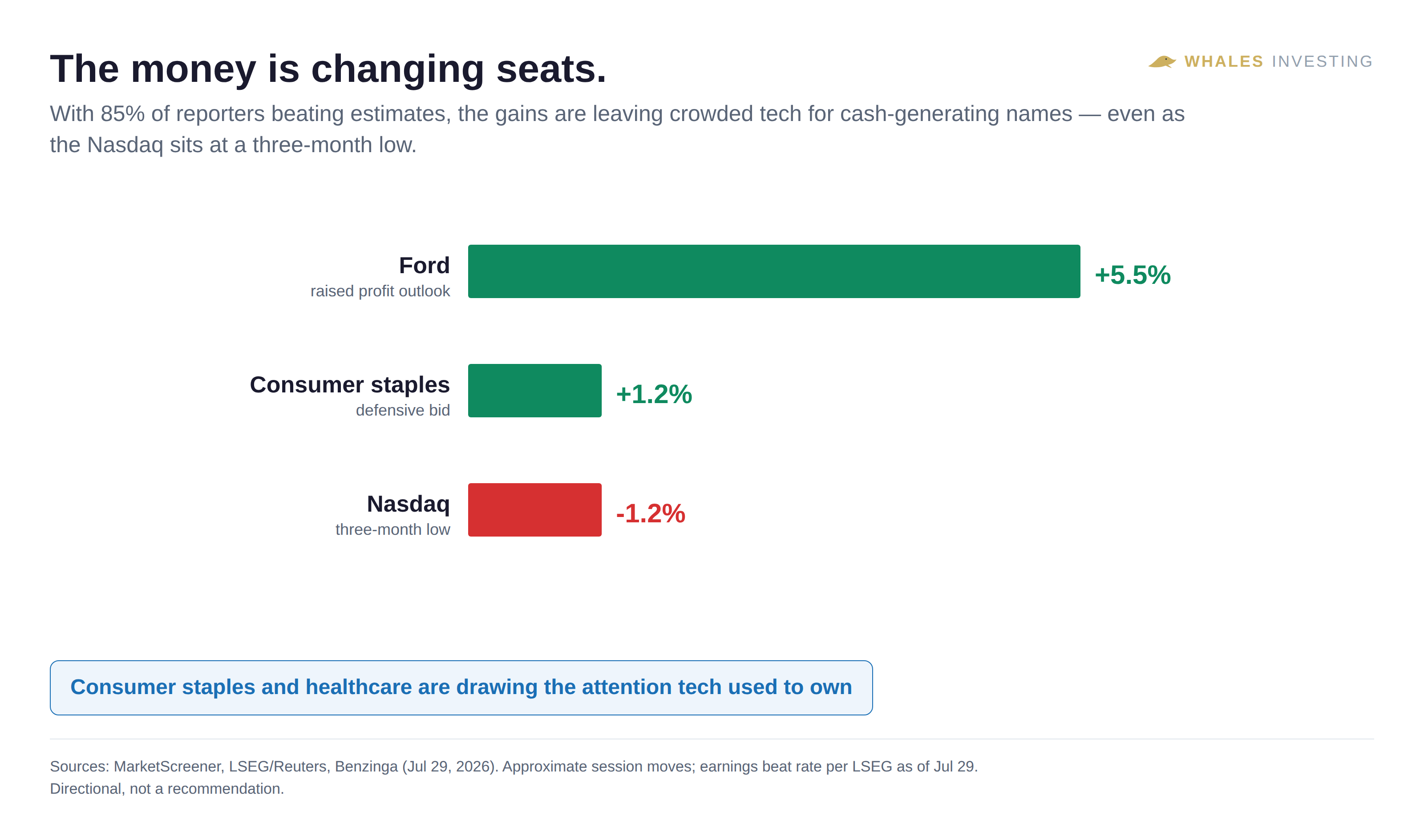
This is the most important signal of the week precisely because it isn’t dramatic. Rotations like this — out of the crowded winners, into the boring cash generators — often mark the real turning points, long after the headlines have moved on. The appetite for a quick, patriotic fix in a nervous market is what the last, briefest pitch this week runs on.
SPONSORED
BREAKING: President Trump announces that he will be paying a “tariff dividend” of at least $2,000 per person.
Stimulus checks are officially back
But why now?
✅ Recent market crashes
✅ Skyrocketing inflation
✅ A weak US dollar
This isn’t just a “bonus” it’s a chance to shield your savings from what’s coming.
And while Washington hands out checks, the people who act before the next wave hits could be the only ones that protect their hard earned savings!
It’s fast, no cost, and could be the smartest move you make this year.
Claim My Free Guide Before the Checks Hit »
P.S. Once those checks start rolling out, this opportunity to protect your savings may slam shut!
I can’t verify the specific “tariff dividend” claim that opens this one, so I won’t repeat it as fact — what I can confirm is only that the President has been pressing publicly for lower rates. Treat a headline like that as the hook it is, not as confirmed policy, and notice how neatly “checks are coming” is wired to “act now or miss out.” The underlying nudge — hold some protection in an uncertain year — is reasonable; the urgency wrapped around it is manufactured.
By tonight you’ll know three things you don’t know now: what the Fed did, what it wouldn’t say, and whether the biggest AI bets are paying their bills. The rotation already told you which way the smart money leans.

Analyst's Note. Three promotions ran above, and all three lean the same way — toward gold and away from the dollar, wrapped in a cartel, a classified document, and a stimulus headline. Each borrows its urgency from a genuinely tense day. So hold the real apart from the theatre. What’s real: the Fed decides at 2 p.m. with a 36 percent chance of the first hike in three years, and a chair who won’t telegraph; Microsoft and Meta report tonight, judged purely on whether AI spending pays, one day after SK Hynix’s 557 percent profit jump still disappointed; and money is rotating out of a Nasdaq at three-month lows into Ford and consumer staples. What’s marketing: resets, cartels, and countdowns. The signal I’d actually carry is the quietest one — the rotation. When the reward stops going to the crowd’s favourite trade, that’s worth more than any briefing sold with a clock on it.
The Bottom Line
Today the waiting ends and the facts arrive: a rate decision built on a genuine split, a new chair’s first real test of nerve, and the two biggest AI spenders reporting into a market that has decided a beat is no longer enough. Any one of them could move everything; all three land within hours.
But the lesson worth keeping isn’t in the drama — it’s in the rotation happening underneath it. Money is leaving the crowded AI trade for companies that generate cash now, on a day when most companies are beating estimates. That is the market quietly repricing what it values, and it’s a better guide to the next year than any single afternoon’s headline.
Protect first. Position for the regime you’re actually in, and pay more attention to where the money is quietly going than to whatever it’s loudly afraid of. Because the capital you keep is the only capital that compounds.
— Hawk