
🐋 Alphabet Beat Every Number and Fell Anyway. Something Changed Last Night.
Cloud revenue grew 82%. Earnings came in ahead. The stock dropped 4% — because the capital spending plan went up to 205 billion dollars. Tesla fell harder for the same reason. Something shifted last n


Desmond Hawk | July 23, 2026
Alphabet reported a quarter that would have been celebrated in any other year. Revenue of $119.8 billion against expectations of $116.9 billion. Search up 17 percent. Google Cloud revenue up 82 percent to $24.8 billion. By every measure that used to matter, it was a beat.
The stock fell more than four percent.
The reason wasn’t hidden in the footnotes. Alphabet raised its capital spending plan for the year to as much as $205 billion, up from a previous top estimate of $195 billion, and said the increase was driven by demand for its AI services. Management explained they would only keep investing if returns look attractive. Investors sold anyway. Tesla, reporting the same evening, dropped over six percent after posting its first quarter of negative free cash flow in more than two years as operating costs surged.
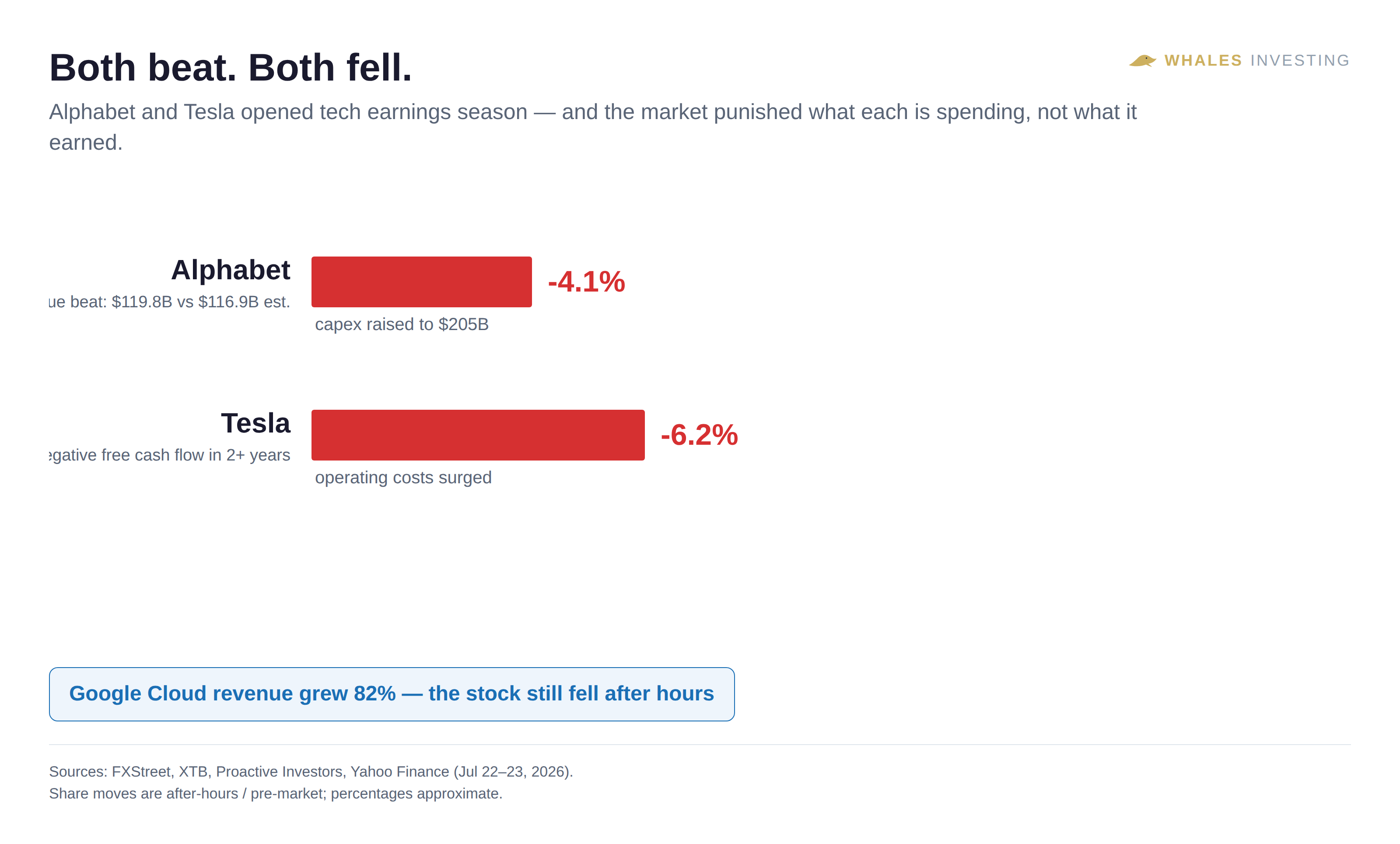
Two of the largest companies on earth delivered results and were punished for what they intend to spend rather than rewarded for what they earned. That’s a change in the rules, and it happened in a single evening. Everything else that moved today is downstream of it.
One. The bottleneck isn’t chips anymore
Here’s the question that follows naturally from a $205 billion spending plan: where does that money physically go?
Not into software licences. It goes into land, steel, transformers, cooling systems and — above all — electricity. And the electricity is the part that has become genuinely scarce. Two headlines landed within days of each other this month that tell the story better than any forecast. On July 16, Reuters reported New York imposed a one-year moratorium on large new data centres over concerns about power costs and pressure on local communities. Four days later, Reuters reported a Texas AI campus secured a $9.8 billion lease.
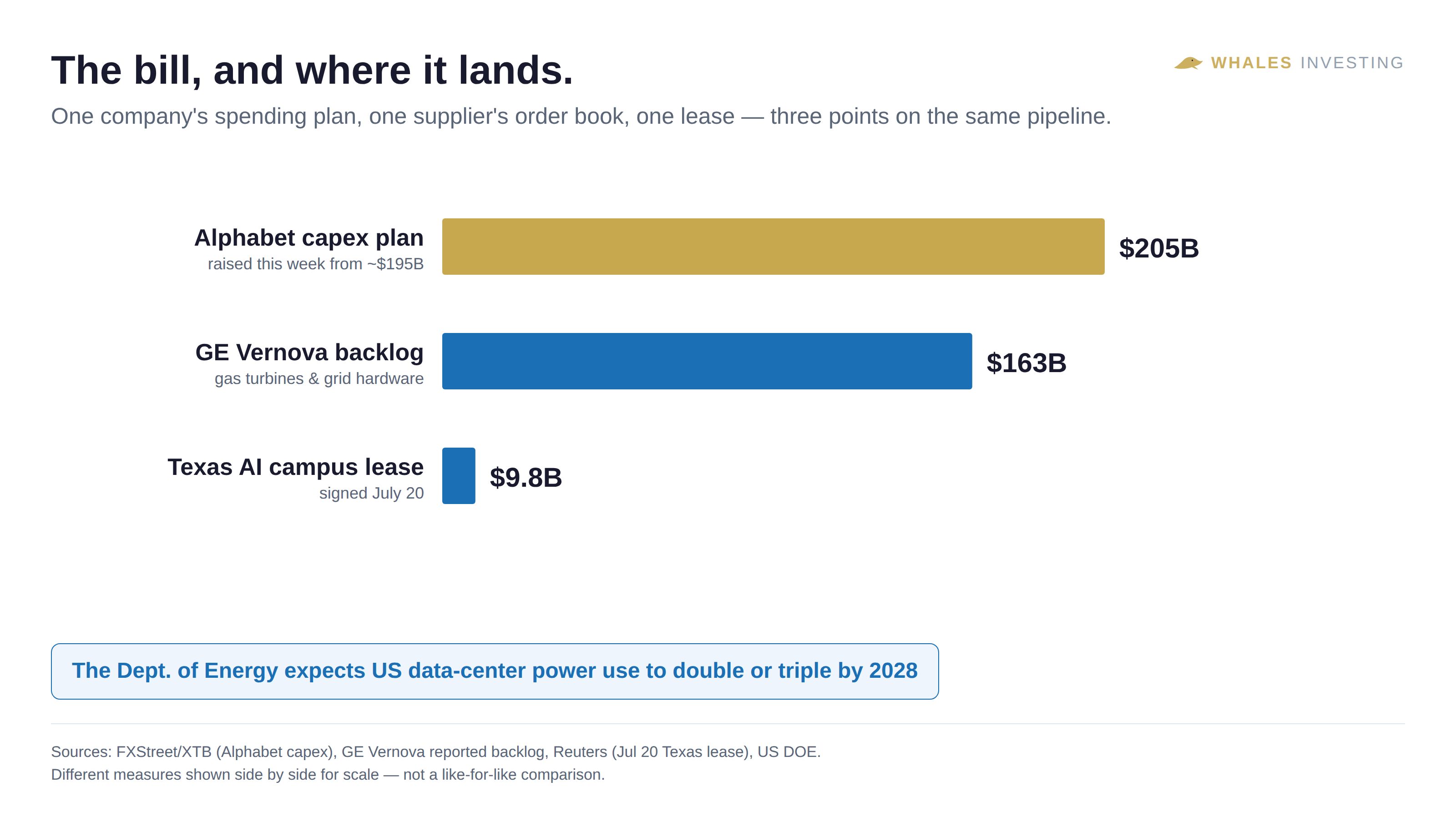
One state said stop. Another said bring your own power. That contrast is the actual state of the AI build-out right now, and it explains why an equipment maker’s order book has become a more honest indicator than any chip company’s guidance. It’s also the subject of a briefing circulating this week from an analyst who went out to see one of these sites in person.
SPONSORED
WHY RUSSIA REPORTEDLY MARKED
THIS A “TOP SEVEN” STRATEGIC
TARGET

Five hours from the nearest major airport, Amy Gamper stood beside a place most Americans could never enter.
But the real surprise was what’s being built across the road.
Some places look empty only because you’re not allowed close enough to see what matters.
The Texas Panhandle is one of those places.
When Altimetry correspondent Amy Gamper arrived, she found herself beside the Pantex complex—the facility the Department of Energy calls a cornerstone of America’s nuclear-security enterprise.1
Pantex helps maintain the nation’s nuclear stockpile. That explains the fences, restricted airspace—and why the briefing Amy received described it as one of Russia’s most important strategic targets.
But Amy wasn’t there to investigate nuclear weapons.
She came to see what was rising across the road.
A 7,500-acre private power and data-center campus designed to deliver as much as 17 gigawatts of electricity—primarily for AI.
To put that into perspective, many large American cities use only a fraction of that amount.
And this project isn’t appearing in isolation.
Two extraordinary headlines landed within days of each other:
On July 16, Reuters reported that New York imposed a one-year moratorium on large new data centers amid concerns about electricity costs, water consumption, and pressure on local communities.
Then on July 20, Reuters reported that a Texas AI campus secured a $9.8 billion lease.2
One state is saying: Stop.
Texas is saying: Bring your own power.
That contrast reveals the real bottleneck in the AI boom.
It isn’t chips.
It isn’t software.
It’s electricity.
The Department of Energy estimates that U.S. data-center power consumption could double or triple by 2028. AI companies are now discovering that buying thousands of advanced chips is useless if they cannot secure enough dependable electricity to run them.
That’s why companies are turning to a little-understood class of industrial gas turbines.
These machines don’t use oil. They generate power from natural gas, can operate around the clock, and can be installed directly beside a data center—allowing AI companies to bypass years-long waits for a traditional grid connection.
The evidence is already arriving.
In February, an SEC filing confirmed that six Siemens Energy turbines had reached the Port of Houston for the Texas Panhandle project. Once installed, they are expected to support its initial gigawatt of on-site power.
Meanwhile, GE Vernova’s equipment backlog has climbed to $163 billion as demand for gas turbines and grid hardware accelerates.
Please understand: I am a senior adviser to Fermi America’s management team. That makes me an insider, so Fermi itself is not—and cannot be—my recommendation.
The opportunity I’m watching lies one level deeper.
It’s in the small group of publicly traded suppliers building the equipment that Fermi, Elon Musk, and virtually every other AI operator may need.
When an AI company can find chips but cannot find power, the most valuable component may not be the computer.
It may be the machine keeping that computer alive.
I’ve prepared a complete briefing revealing the suppliers positioned behind this power shift—including their names and ticker symbols.
Whatever you make of the recommendation at the end of it, the disclosure in the middle is worth noting: the author states plainly that he advises the management team of the company at the centre of the story, and therefore excludes it from his own suggestions. That’s more candour than most promotional material offers, and it doesn’t oblige you to act on anything.
Two. The money left Alphabet and landed somewhere else
Watch what happened overnight. American investors sold Alphabet on the spending announcement. Then Asian markets opened, and the chipmakers rallied — Korea’s Kospi rose 2.8 percent, with Samsung Electronics and SK Hynix both gaining more than three percent on expectations they’ll be among the beneficiaries of exactly that spending. Nasdaq futures erased their earlier losses.
This is the whole mechanism in one night. When a customer announces a larger bill, the customer’s shareholders wince and the suppliers’ shareholders celebrate. The $205 billion doesn’t evaporate — it becomes revenue for whoever sells the chips, the turbines, the cooling and the racks.
It’s worth being precise about why the two sides react differently, because the reason isn’t sentiment. For Alphabet, that spending is an outflow today against revenue that arrives — if it arrives — over years, and every dollar of it must be depreciated on the income statement long before any customer pays for the capacity it creates. For a turbine manufacturer or a memory-chip maker, the identical dollar is an order booked this quarter, at a known margin, with delivery scheduled. Same transaction, opposite accounting. One side carries the timing risk; the other collects.
Which is also why the market’s tolerance for these announcements has a limit that nobody can locate in advance. As long as investors believed the payoff was certain, they treated capital spending as a signal of ambition. The moment that certainty softened — and Alphabet’s own comment that third-quarter comparisons might look less flattering did soften it — the same number reads as a cost rather than a commitment. Nothing about the underlying business changed between those two readings. Only the willingness to fund the wait.
That rotation is neither new nor secret, but it does get louder every time one of these announcements lands. It’s the premise behind another pitch making the rounds this week.
SPONSORED
This is the ONLY AI wealth-building opportunity you should be watching right now.
No. It's not about Nvidia, Tesla, or Meta...
It’s about one overlooked company profiting off AI “digital goldmines” that are poised to experience 100x growth very soon.
This new opportunity will change the market and make investors a lot of money.
That's why it has received a $500 billion commitment from President Trump himself…
I have no way to verify a growth claim like that and won’t pretend otherwise. The observable part is narrower and still useful: last night the market paid the supplier and charged the buyer, and it did so within hours.
Three. Oil made it five sessions in a row
While earnings held the headlines, crude quietly kept climbing. Brent reached roughly $98 a barrel this morning — up about three dollars from yesterday and nearly thirty dollars higher than a year ago — extending gains for a fifth consecutive session.
The escalation is real and it is new. Iran-backed Houthi militants attacked two Saudi oil tankers in the Red Sea with missiles and drones, the first direct strikes on tankers in that waterway, threatening a key alternative export route for Saudi crude. The President warned the United States would strike Iranian infrastructure if Tehran attacked shipping through the Strait of Hormuz. There were also reported attacks on a Caspian Pipeline Consortium terminal in the Black Sea.
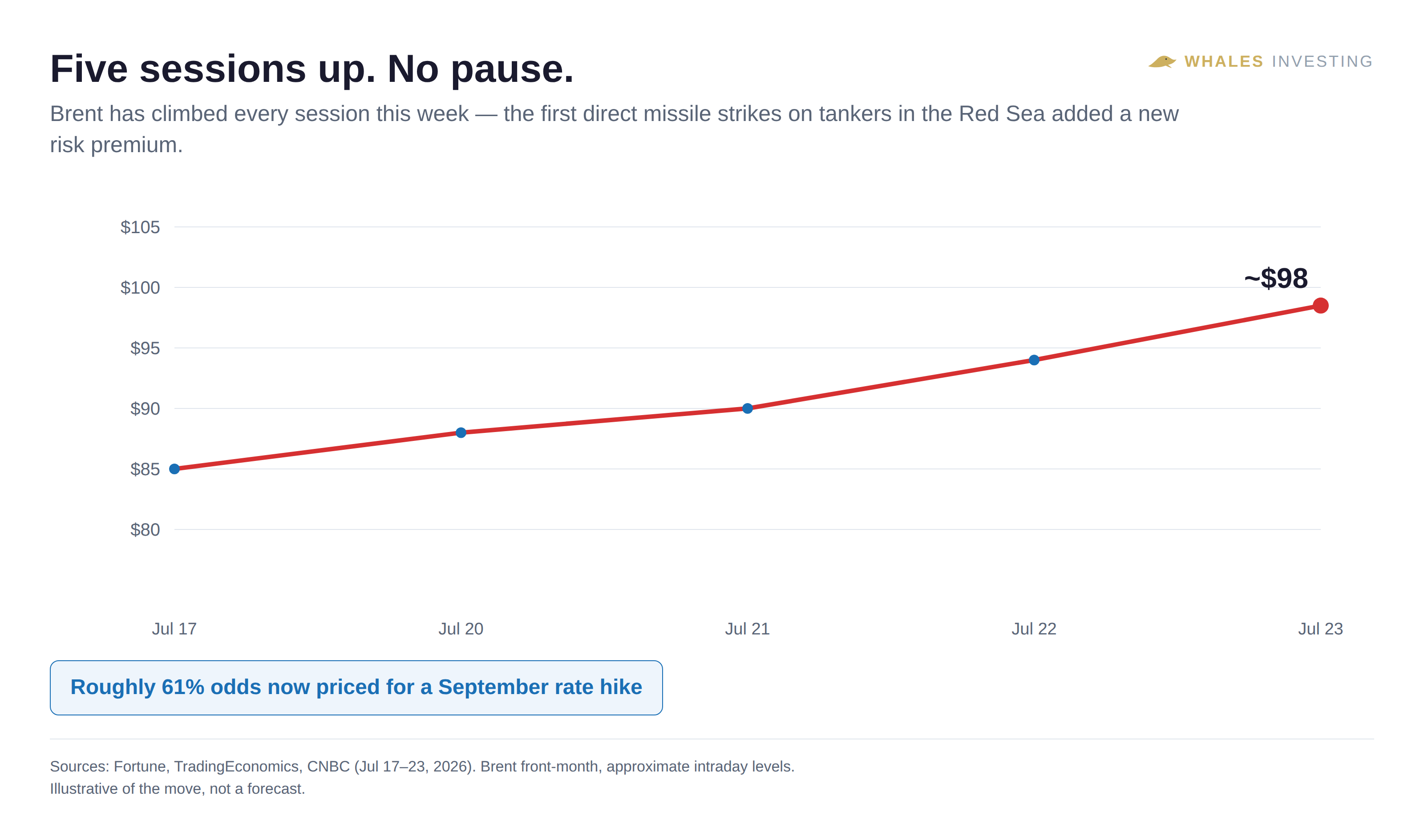
I’ll keep the geopolitics brief — people are living through this and it deserves better than a trading angle. The financial consequence is simple enough to state: energy at these levels feeds through to nearly every price in the economy with a lag, which is why traders now assign roughly 61 percent odds to a Federal Reserve rate hike by September, even as next week’s meeting is expected to hold rates steady.
Higher rates are the enemy of anything valued on distant future earnings — which is precisely the category most AI investments fall into. That connection, between the cost of energy and the price of a growth story, is what makes today’s four headlines a single story rather than four.
SPONSORED
Editor’s Note: If you want to know which chipmaker could be the next NVIDIA, just ask Jeff Brown.
He knows more about AI chips than practically anyone on the planet — Thanks to his senior executive roles at Qualcomm, Juniper Networks, and NXP Semiconductors…
And Jeff just uncovered that one tiny chipmaker — 148 times smaller than NVIDIA — is set to provide Musk 5 billion chips in the next two years alone.
Click here for the full story or read more below.
$1,000 into $64.5 million.
$1,700 into $55 million.
$1,000 into $200 million.
These gains sound impossible…
But they are a reality for early investors in Musk's ventures.
And right now, Wall Street is paying close attention to Musk's brand-new venture…
Because top market analysts say it could be worth $12.8 trillion.
For context…
That's more than the current valuations of xAI, SpaceX, PayPal and Tesla… COMBINED.
And here's the craziest part:
That $12.8 trillion figure is based on a breakthrough AI product Musk is yet to launch.
It's not an AI chatbot like Grok, or even a humanoid robot…
This is something you've likely never seen or heard of before.
That's why one ticker tied to Musk could go parabolic in the coming weeks…
It's a tiny company trading around $33…
And most people have no idea it has any connection to Musk.
But an upcoming Musk announcement could change that entirely…
And send the share price into the stratosphere.
If you missed Musk's previous "millionaire-makers," you do not want to miss this.
Past results of that magnitude describe a handful of survivors and say nothing about what any new position does. Treat those figures as marketing, not as evidence, and the underlying observation still stands on its own.
Four. And into this, the biggest listing of the year
Now place one more fact alongside the others. Anthropic — the AI company behind Claude — is preparing to go public on the Nasdaq as soon as October at a valuation reported near $965 billion, with Goldman Sachs, Morgan Stanley and JPMorgan running the process. It filed confidentially on June 1. Secondary markets are already pricing it between $1.05 and $1.15 trillion, and the offering is expected to raise upwards of $60 billion.
It arrives into a market that just spent an evening punishing two profitable giants for spending too much on AI. That’s the tension worth holding: enormous private capital is queuing to go public precisely as public investors begin asking harder questions about what the build-out costs.
There’s a detail in the SpaceX prospectus that makes the circularity concrete. SpaceX holds a compute contract with Anthropic reported at $1.25 billion a month through 2029. One company in this pipeline is paying another company in this pipeline, at scale, and both valuations rest partly on that arrangement continuing. None of that is improper — it’s how infrastructure businesses have always been financed — but it does mean the sector’s numbers are more interconnected than a list of separate valuations suggests. When you see three companies valued in the hundreds of billions, it’s worth asking how much of each one’s revenue comes from the other two.
There’s a preview coming. SpaceX, which listed in June at roughly $1.77 trillion and has since traded around and below its $135 IPO price, reports its first quarterly results on August 6 — the same day its lock-up expires and early shareholders can sell. That combination, first earnings and first unlocked shares on a single date, will tell you a great deal about how much appetite really exists.
Yesterday the market paid for ambition. Today it asked for the invoice. Both AI listings ahead will be priced by whichever mood is in the room.
Analyst's Note. Three promotions appear above and each wants your attention on a different corner of the same build-out — the power equipment, the overlooked supplier, the small chipmaker. Read them as sales material, because that's what they are, and notice how neatly a genuine shift in the market gets turned into urgency. The shift itself is documented: Alphabet beat expectations and fell on a $205 billion spending plan, Tesla fell on negative free cash flow, Asian chipmakers rose on the same news that sank their customer, Brent ran five sessions to $98 after tankers were hit in the Red Sea, and a $965 billion listing is queuing up behind it. What I take from that is not a ticker. It's that the market has started separating who pays for this boom from who gets paid by it — and that distinction is worth more to you than any single recommendation above.
The Bottom Line
For three years the reflex was simple: announce AI spending, watch the stock rise. Last night that reflex broke. Two companies delivered results and were marked down for their ambitions, while the firms selling them equipment were marked up within hours of the same announcement.
Underneath it sits a physical constraint that no earnings call can talk its way past — electricity, land and turbines take years, not quarters — and an energy price climbing on a fifth straight session while the Fed conversation moves toward hikes rather than cuts.
Protect first. Position for the regime you’re actually in, and ask of every AI story whether the company is paying the bill or collecting it. Because the capital you keep is the only capital that compounds.
— Hawk